
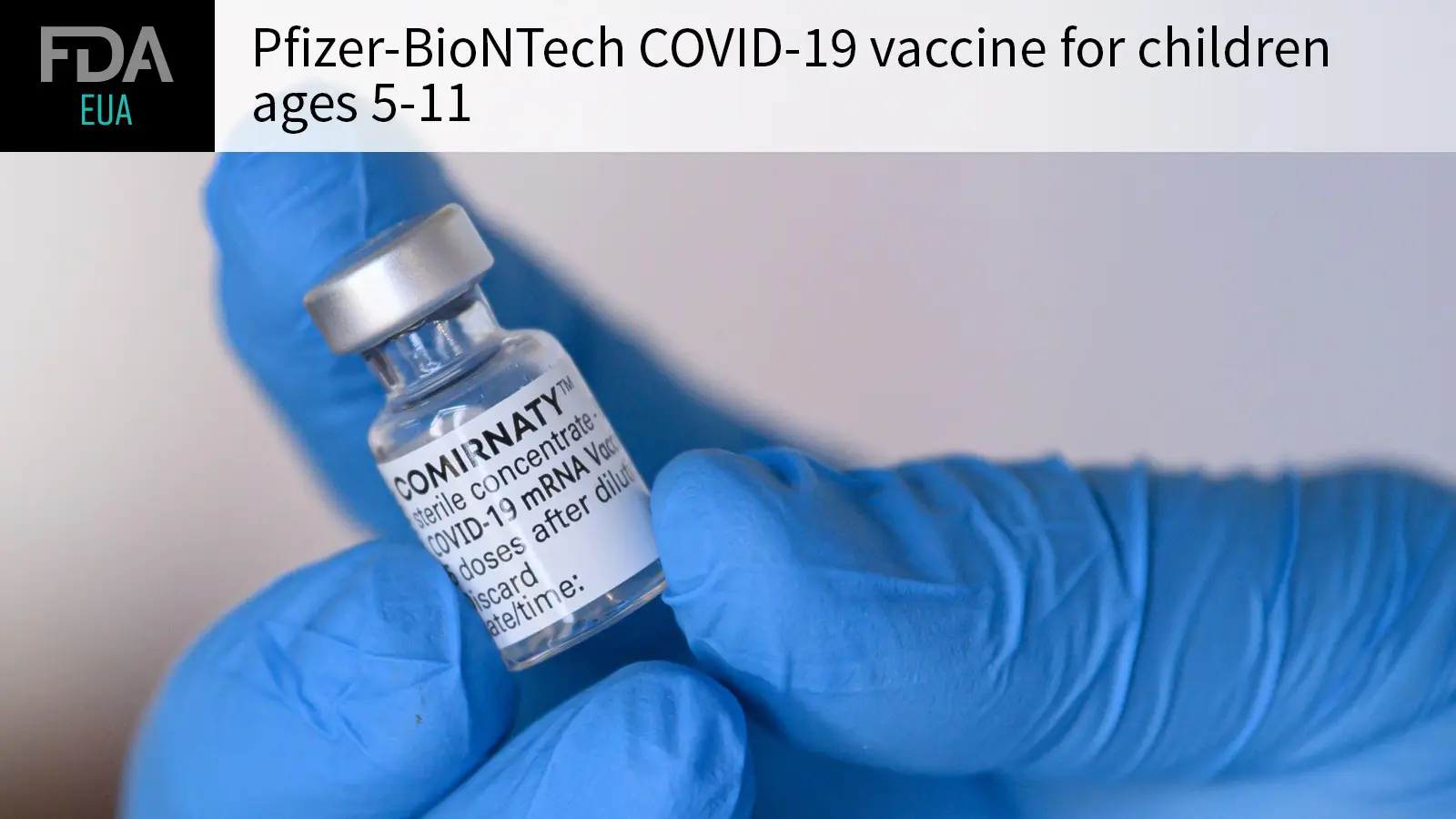
- The agency highlights the immune response and safety data in children aged 5 to 11.
By Molly Walker, Deputy Managing Director, MedPage Today
The Pfizer-BioNTech COVID-19 vaccine was authorized for use in children as young as 5 years old, the first in the United States to receive an Emergency Use Authorization (EUA) in this younger age group, the FDA announced Friday.
The agency amended the existing EUA to include children aged 5 to 11 after the vaccine produced an immune response comparable to that seen in people aged 16 to 25, and showed 91% efficacy in a small descriptive analysis.
The Pfizer vaccine was first authorized in December 2020 for people aged 16 and over, and in May for adolescents aged 12 to 15.
The vaccine will be administered in a series of two doses, with a 3-week interval, at a lower dose of 10-μg each.
To emphasize the extent of the virus in children, the FDA noted that children aged 5 to 11 currently account for 39% of COVID cases among individuals aged 18 and under, with 8,300 hospitalizations and 146 deaths.
“As a mother and a physician, I know that parents, caregivers, school staff, and children have been waiting for today’s authorization. Vaccinating the youngest children against COVID-19 will bring us closer to returning to normal,” said Acting FDA Commissioner Dr. Janet Woodcock in a statement.
In fact, at a press conference held on Friday afternoon, both Dr. Woodcock and Dr. Peter Marks, director of the FDA's Center for Biologics Evaluation and Research (CBER), said that they would both give the vaccine to their children if they were in this age group without hesitation.
"Whenever we think about children, we try to be as careful as possible with the products," Marks said.
The FDA's Vaccines and Related Biologicals Advisory Committee (VRBPAC) "voted overwhelmingly in favor" of the EUA, the agency said in its statement. However, reporters cited back-and-forth debate within the committee regarding the possibility of limiting the EUA's scope to high-risk children.
Marks said that what finally convinced them was that at least a third of the children hospitalized with COVID-19 had no identifiable risk factors, and "trying to limit the highest-risk groups could create problems."
Woodcock added that children from racial and ethnic minorities are "hospitalized more frequently" and "we want to make sure that the entire vulnerable population is vaccinated," he said.
A reporter asked why a parent should vaccinate their child if COVID cases are declining, and Woodcock said that increased vaccination will help decrease transmission among all age groups.
"If I had young children... I wouldn't want to run the risk of them... developing long-term multisystem inflammatory syndrome or being hospitalized because of the virus," she said.
Marks added that some experts are predicting a winter surge of the Delta variant, especially when people start gathering at home.
The supporting data comes from the phase II/III study C4591007, which involved 3,109 people who received the vaccine and 1,528 who received a placebo.
The vaccine met the criteria for successful immunization, with increases in geometric mean titers of neutralizing antibodies among children aged 5 to 11 years comparable to those in individuals aged 16 to 25 years. Comparable seroreaction rates were also observed between the two groups compared to baseline.
A descriptive analysis found a vaccine efficacy of 90.7% (95% CI: 67.4–98.3), with three cases of COVID-19 in the vaccine group and 16 in the placebo group. None of the cases met the criteria for severe COVID-19. Approximately 20% of those who acquired COVID-19 had comorbidities, and most infections occurred between July and August of this year.
Adverse events (AEs) were similar to those in other populations, with no cases of myocarditis or pericarditis, anaphylaxis, or death. The most frequent AE was fatigue (39%), followed by headache (28%) and muscle pain (12%). Most systemic AEs were mild or moderate and resolved within one to two days of onset, FDA staff noted.
At the briefing, Marks sought to allay safety concerns by noting that the FDA will continue to monitor safety data on this vaccine along with the CDC after its authorization, including tracking "very rare side effects."
"When we authorize a vaccine like this, it's not like we're discharging someone from the hospital and saying goodbye," he said.
On Tuesday, November 2, the CDC's Advisory Committee on Immunisation Practices will meet to discuss new clinical recommendations, the agency said.