
By Giulia Alfieri
Covax, the international program that promotes equitable access to Covid vaccines, is not delivering the expected results, and the latest figures remain the lowest.
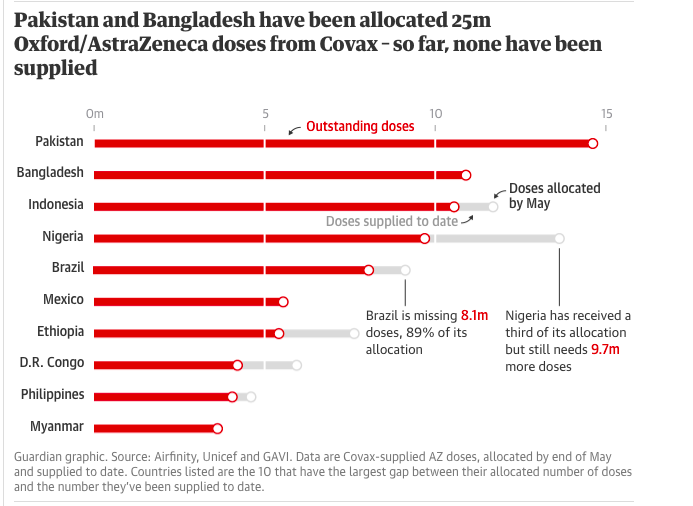
Large, densely populated countries like Indonesia and Brazil have so far received only about 1 in 10 of the AstraZeneca doses expected by May, while Bangladesh, Mexico, Myanmar, and Pakistan are among those that have not received any vaccine doses through COVAX, the international program that aims to ensure equal access to COVID-19 vaccines.
And these are just a few examples. According to an analysis by The Guardian , Covax has delivered, on average, only 1 out of every 5 doses of the AstraZeneca vaccine that it had estimated would arrive in participating countries by May.
ISSUES
The British newspaper article illustrates the problems for global access to vaccine doses: the cost of export bans, hoarding and supply shortages have hampered the implementation of the program that represents the fundamental livelihood for many developing countries.
THE DATA
Covax has so far reached 74 countries with 33 million vials. Only small states like Moldova, Tuvalu, Nauru, and Dominica have received all the expected doses, but the vast majority of those listed in the table below have received a third or less of their allocated doses to date.
In Africa, perhaps less than 1.7% of the population is immunized. Rwanda, reports The Guardian , received only 32% of its allocation, the highest percentage on the continent. Countries such as Nigeria, Kenya, Ethiopia, and the Democratic Republic of Congo each received approximately 28% of their planned doses.
Overall, according to the latest updates last Wednesday, Covax had delivered around 40.2 million of the 187.2 million it had planned to distribute during or by the end of May.
Without vaccines for the poorest countries, the pandemic will last 7 years and 2.5 billion people still lack doses.
"We must develop a democratization of care for all, otherwise there will be no future for anyone." He denounced Greta Thunberg, highlighting the problem of vaccine inequality and announcing a donation of 100,000 euros from his foundation to the Covax program.
“The international community must do more to address the tragedy of vaccine inequality,” the activist added. “We have the means at our disposal to correct the vast imbalance that exists in the world today in the fight against Covid. As with the climate crisis, we must first help the most vulnerable.”
FREE ACCESS TO CARE
According to the World Health Organization (WHO), health is a state of complete physical, mental, and social well-being, and not merely the absence of disease. Article 32 of the Constitution establishes that "the Republic protects health as a fundamental right of the individual and in the interest of the community, and guarantees free medical care to the indigent," as emphasized by Aldo Morrone, Scientific Director of San Gallicano.
“A collective threat like the Covid pandemic requires solidarity and the sharing of scientific knowledge. The disbursement of public funds for scientific research must always be accompanied by guarantees of availability and prices accessible to all, starting with the most vulnerable populations. To develop vaccines, large pharmaceutical companies have received nearly 100 billion euros in public funds,” the chief scientist continued.
SUSPEND PATENTS
“There are important precedents. Not only the battle for free access to antiretrovirals in the early 2000s. During World War II, the US government managed to increase penicillin production thanks to collaboration between companies and public universities, regardless of intellectual property. This example is cited in an editorial published in Nature , with the telling title ' It is time to consider temporarily suspending Covid vaccine patents .' We, too, are calling for a suspension of Covid vaccine patents. The virus will continue to circulate and evolve, negating the economic efforts and sacrifices made by everyone,” Morrone added.
“We will be forced to count millions more dead: a humanitarian catastrophe. At least temporarily, we are asking for the suspension of patents to ensure the production of enough vaccines to meet the needs of the world's population, especially the poorest. The future of everyone is at stake.”