
By Helen Branswell @HelenBranswell July 16, 2019
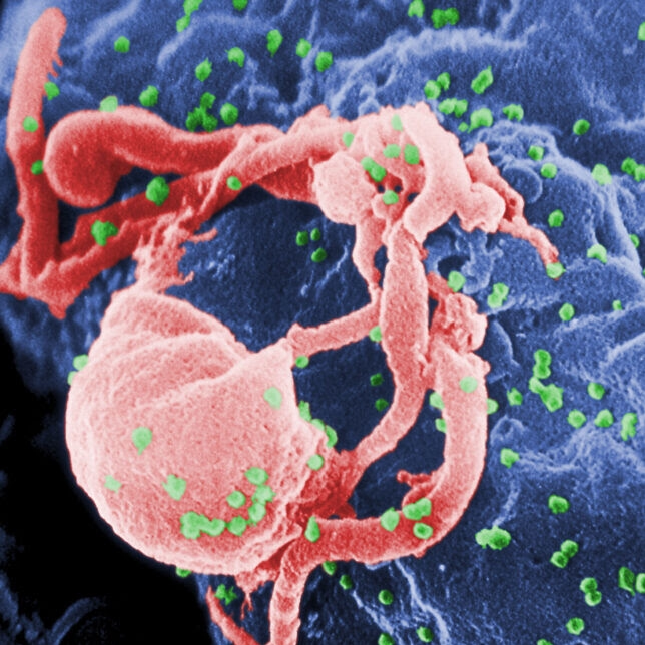
Scanning electron micrograph of HIV-1 budding from cultured lymphocytes.
For more than 50 years, the RNA remained hidden in a lymph node that had been removed from a 38-year-old man in what is now the Democratic Republic of Congo. That lump of tissue, about the size of a fingernail on a little finger, had been sealed in a protective block of paraffin.
Once freed from their waxy sheath, scientists at the University of Arizona were able to extract from the tissue a nearly complete genetic sequence of an HIV virus: the oldest nearly complete genetic code for an HIV-1 virus recovered so far, and one that supports the theory that the virus that causes AIDS began to be transmitted between people in the first or second decade of the 20th century.
"There are many years of work there," said Michael Worobey, the scientist whose group carried out the work, about the research, which was recently published on the preprint site bioRxiv. "We've been working on that sequence alone for more than five years."
Worobey, whose lab has repeatedly performed virological archaeology on samples of old blood and tissue, said the paper has not yet been submitted to a scientific journal for publication. As such, it has not yet gone through the peer-review process where independent scientists, so to speak, put it through its paces.
But Oliver Pybus, professor of evolution and infectious diseases at Oxford University, praised the work.
“Generating a complete genome… from an archived tissue specimen is technically impressive,” Pybus told STAT. “While their discovery doesn’t substantially alter our current model of the early genetic history of the AIDS pandemic, it does enhance our confidence in conclusions previously drawn from modern, partial HIV genetic sequences.”
Dr. Jacques Pepin, a professor of infectious diseases at the University of Sherbrooke in Quebec, who has written about the history of the AIDS epidemic, called Worobey's latest work a "technological feat." Pepin is working on a second edition, "The Origin of AIDS," due for release in late 2020, and said this work will be a factor in its updates.
The sample examined dates back to 1966. The extracted sequence is a decade older than the previous oldest complete sequence. It provides a snapshot of what the virus looked like when it was circulating undetected in Central Africa 15 years before a cluster of unusual infections among gay men in the United States led to the recognition of a new disease that would eventually be called AIDS.
Scientists can use the genetic codes of the viruses that infected people in the early days of the AIDS epidemic to try to pinpoint when the HIV virus jumped from primates to humans. By studying differences in viral sequences, scientists estimate how long ago the known sequences might have diverged from a common source. They aren't told when the event occurred, but it can suggest it had to have been before a particular time, Worobey said, adding that the new data suggests the jump probably didn't happen in the 1920s.
Although there have been several estimates of when HIV began to be transmitted between people, most now focus on the early 20th century. Pepin said it could even have happened in the late 19th century.
Worobey, who has developed a method for extracting viral genetic material from samples that he calls a "drilling hammer," spent time in the Democratic Republic of Congo about 20 years ago while working on his Ph.D. at Oxford University
He learned about a repository of old tissue samples at the University of Kinshasa, and with the help of co-author Dr. Jean-Jacques Muyembe, a renowned Ebola expert and director of the DRC's National Institute of Biomedical Research, he received permission to study them, looking to see if any contained HIV RNA. The tissue samples were taken from patients in Kinshasa, then Leopoldville, for diagnostic purposes between 1959 and 1967.
"It was sort of like burning in cardboard boxes in a big pile in the back room," Worobey said of the collection.
From: https://www.statnews.com/2019/07/16/hiv-genetic-code-extracted-evidence-virus-emergence/