
"Many of us thought there was no hope in hell of surviving," said Frederick Williams, 55, who tested positive for HIV in 1986. "I had waves of friends who died, and they died quickly."
DENISE RYAN Updated: July 28, 2019
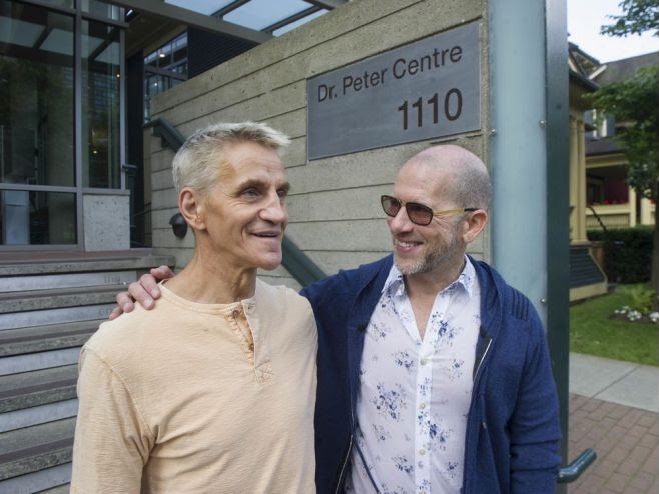
Frederick Williams, a longtime AIDS survivor (left), and Scott Elliot, Executive Director of the Dr. Peter AIDS Foundation. Photo: Jason Payne / Postmedia JASON PAYNE / PNG
Every Wednesday night at the Dr. Peter Center, 38 men gather to meditate, laugh, listen to music, share a meal, and talk about their lives.
Men are long-term HIV survivors.
"Many of us thought there was no hope in hell of surviving," said Frederick Williams, 55, who tested positive for HIV in 1986. "I had waves of friends who died, and they died quickly."
Williams said that many survivors lost romantic relationships, friendships, and job opportunities, and experienced isolation and stigma.
"They told us not to bother going to college or planning a career, you won't be here," Williams said.
Last year, Williams, who has a disability, was participating in the Dr. Peter Center Evening Program, a pilot clinical project designed to address the special needs of men over 50 living with HIV.
Frederick Williams, a longtime AIDS survivor. JASON PAYNE / PNG
Since the introduction of antiretroviral medication, HIV has become a manageable chronic disease, but it remains a very complex medical condition with significant social stigma, said Scott Elliot, executive director of the Dr. Peter Center.
Isolation, post-traumatic stress disorder, loneliness, internalized shame, and lack of acceptance in their own communities are just some of the social challenges that many still face.
"Thirty years ago, nobody thought they were going to live," Scott said. "There was a lot of trauma."
The Dr. Peter Center was founded by Dr. Peter Jepson-Young in 1992 to provide comfort and medical care to patients with AIDS.
With the advent of antiretroviral therapy, and as the demographic most affected by HIV shifted from gay men to the intravenous drug-using community, the Dr. Peter Center changed its programs to serve that community.
"Among the HIV community we now serve, 80 percent have mental illness, 80 percent have substance abuse, and 100 percent have chaotic life circumstances," Scott said.
Scott Elliot, executive director of the Dr. Peter AIDS Foundation. JASON PAYNE /PNG
The cohort of "aging gay men with HIV" no longer fits the model of services the center provided, Scott said.
As data emerged showing that long-term HIV survivors experience unique health challenges, the Dr. Peter Centre became concerned that this demographic would again experience neglect.
“They’re aging faster, developing comorbidities such as neurological difficulties, bone density problems, depression, challenges with the pill burden—all things we expect with age, but appearing earlier in this population,” Scott said. “We saw a need and wanted to help reach it.”
Since its inception in 2017, the program has been a great success, Scott said.
The 38 participants have a voice in the program and even developed a self-reported quality of life survey index that included the questions the participants considered most important: physical and mental health, as well as connection and social support.
“They’ve made new friends,” Scott said. The dinners are a highlight, with candid conversations ranging from lighthearted banter to politics and trends, to dealing with the burden of the pill, to deeper issues related to stigma and shame.
“This is a place where we can talk about anything. We don’t have to explain ourselves,” said Williams, who said the program has brought about a “calm” and a “recovery of self.”
“Being alive after all these years is amazing, but it’s difficult to connect with society because we know we experienced this epidemic, we lived through it, we survived it. It’s a great place to vent and we have a lot of fun.”
The fun includes music, art, trivia games, and a grand social dinner prepared by the chefs of the Dr. Peter Center.
"We even took the leftovers home, and we hope we made one or two friends," Williams said.
The Dr. Peter Center is now developing a similar program for women with HIV.
From: https://vancouversun.com/news/local-news/dr-peter-centre-has-had-to-reinvent-itself-as-the-face-of-hiv-changed