
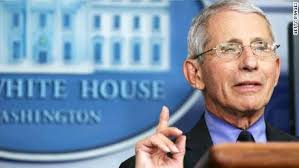
A spokesman for Dr. Fauci says he has been "totally truthful," but a new letter belatedly acknowledging the National Institutes of Health's support for virus research adds more heat to the ongoing debate over whether a lab leak could have triggered the pandemic.
BY KATHERINE EBAN
"I am bothered by the lie he is now spreading."
Dr. Anthony Fauci seemed to channel the frustration of millions of Americans when he uttered those words during a profanity-laden, Twitter-friendly Senate hearing on July 20. You didn't have to be a Democrat to be fed up with all the xenophobic accusations and blatant misinformation, mostly from the right, including the claim that COVID-19 was a bioweapon created in a lab.
Dr. Fauci's immediate target was Senator Rand Paul, who pressed the nation's top physician to reveal whether the National Institutes of Health had ever funded the risky coronavirus research at the Wuhan Institute of Virology. However, according to new information released by the National Institutes of Health, Paul may have uncovered something.
The NIH sent a letter to members of the House Energy and Commerce Committee acknowledging two facts. One was that EcoHealth Alliance, a New York-based nonprofit organization that partners with distant laboratories to research and prevent outbreaks of emerging diseases, had indeed enhanced a bat coronavirus to make it potentially more infectious to humans—what the NIH letter described as an “unexpected outcome” of research it funded and conducted in collaboration with the Wuhan Institute of Virology. The second was that EcoHealth Alliance violated the terms of its grant, which stipulated that it must report if its research increased the viral growth of a pathogen tenfold.
The NIH based these revelations on a progress report on the investigation that EcoHealth Alliance sent to the agency in August, roughly two years later than expected. An NIH spokesperson said that Dr. Fauci was “completely truthful in his statements to Congress” and that he did not have the progress report detailing the controversial investigation when he testified in July. But EcoHealth Alliance appeared to contradict that claim, saying in a statement, “This data was reported as soon as we became aware of it, in our fourth-year report in April 2018.”
The NIH letter and accompanying analysis stipulated that the virus Eco Health Alliance was investigating could not have caused the SARS-CoV-2 pandemic, given the considerable genetic differences between the two. In a statement released Wednesday, NIH Director Dr. Francis Collins said his agency “wants to set the record straight” about Eco Health Alliance’s research, but added that any claim that it could have caused the SARS-CoV-2 pandemic is “demonstrably false.”
Eco Health Alliance said in a statement that science clearly demonstrated that its research could not have caused the pandemic, and that it was "working with the NIH to quickly address what we believe is a misconception about the grant's reporting requirements and what our research data showed."
However, the NIH letter, which comes after months of congressional requests for more information, seems to underscore that America’s leading scientific institution has not been very forthcoming about the risky research it has funded and failed to adequately oversee. Instead of helping to trace the origins of COVID-19, with the pandemic now in its 19th month, the NIH has been dodging the issue, defending its grant system and scientific criteria against a growing wave of questions. “It’s just another chapter in a sad story of inadequate oversight, disregard for risk, and insensitivity to the importance of transparency,” said Dr. David Relman, a microbiologist at Stanford. “Given all the sensitivity surrounding this work, it’s hard to understand why the NIH and EcoHealth have yet to explain a number of irregularities in the reporting on this grant.”
Early last month, The Intercept published more than 900 pages of documents it obtained through a Freedom of Information Act lawsuit against the NIH, related to the EcoHealth Alliance grant investigation. But one document was missing: a fifth and final progress report that EcoHealth Alliance was required to submit at the end of its grant period in 2019.
In its letter Wednesday, the NIH included that missing progress report, which was dated August 2021. That report described a “limited experiment,” according to the NIH letter, in which lab mice infected with an altered virus became “sicker than those infected with” a natural one.
The letter made no mention of the phrase “gain-of-function research,” which has become central to the bitter clashes over the origins of COVID-19. This controversial type of research—the manipulation of pathogens to make them more infectious in order to measure their risk to humans—has divided the virology community. A review system established in 2017 requires federal agencies to give special scrutiny to any research proposal that involves increasing a pathogen’s infectivity to humans.
Dr. Fauci's spokesperson said that the Eco Health Alliance research did not fall under that framework, as the funded experiments "were not reasonably expected to increase transmissibility or virulence in humans."
However, Alina Chan, a Boston scientist and co-author of the book Viral: The Search for the Origin of COVID-19, said the NIH was in a “very difficult position.” They were funding research internationally to help study new pathogens and prevent them. But they had no way of knowing what viruses had been collected, what experiments had been conducted, and what accidents might have occurred.
While scientists remain at an impasse over the origins of the pandemic, another revelation last month made it clear that Eco Health Alliance, in partnership with the Wuhan Institute of Virology, intended to conduct the kind of research that may have inadvertently led to the pandemic. On September 20, an internet sleuth group calling itself DRASTIC (short for Decentralized Radical Autonomous Search Team Investigating COVID-19) published a leaked $14 million grant proposal that Eco Health Alliance had submitted in 2018 to the Defense Advanced Research Projects Agency (DARPA).
He proposed partnering with the Wuhan Institute of Virology to construct SARS-related bat coronaviruses into which they would insert "human-specific cleavage sites" as a way to "assess the growth potential" of the pathogens. Perhaps unsurprisingly, DARPA rejected the proposal, deeming it did not fully address the risks of gain-of-function research.
The leaked grant proposal caught the attention of several scientists and researchers for a reason. A distinctive segment of the SARS-CoV-2 genetic code is a furin cleavage site that makes the virus more infectious by allowing it to efficiently enter human cells. That is precisely the feature that EcoHealth Alliance and the Wuhan Institute of Virology had proposed to engineer in the 2018 grant proposal. “If I applied for funding to paint Central Park purple and was denied, but a year later we woke up to find Central Park painted purple, I would be the prime suspect,” said Jamie Metzl, former executive vice president of the Asia Society, who sits on the World Health Organization’s advisory committee on human genome editing and has been calling for a transparent investigation into the origins of COVID-19.
Claims about a laboratory origin, made without evidence in April 2020 by President Donald Trump, have become a legitimate and protracted search for the truth that even US intelligence agencies seem unable to resolve. This summer, an intelligence review ordered by President Joe Biden did not reach definitive conclusions but left open the possibility that the virus leaked from a laboratory in Wuhan, China.
The NIH letter to Congress stated that the agency is giving EcoHealth five days to submit any unpublished data from the experiments it funded. Republican leaders on the House Energy and Commerce Committee, who in June called on the NIH to demand that data, said in a statement Wednesday that “it is unacceptable for the NIH to delay asking EcoHealth Alliance to submit unpublished data on risky research that they were obligated to conduct under the terms of their grant.”
Meanwhile, members of the DRASTIC coalition have continued their investigation. One member, Gilles Demaneuf, a data scientist from New Zealand, said, “I can’t be sure that COVID-19 originated from a research-related accident or an infection from a sampling trip. But I am 100% certain that there was a massive cover-up.”