
PrEP programs and recruitment
Krishen Samuel July 30, 2019
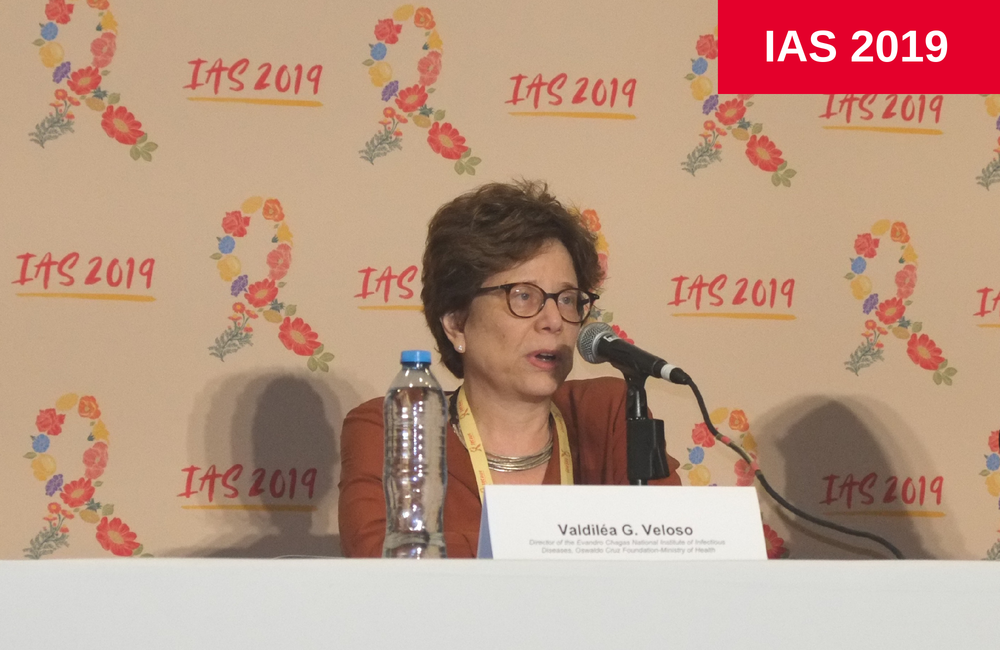
Valdiléa Veloso of ImPrEP at IAS 2019. Photo by Roger Pebody.
More than 5,000 men who have sex with men and transgender women have enrolled in the ImPrEP demonstration project in Brazil, Mexico, and Peru, with early results showing good levels of adherence and continuation, the 10th International AIDS Society Conference on HIV Science (IAS 2019) in Mexico City heard last week. This was one of several studies reporting on efforts to expand pre-exposure prophylaxis (PrEP) in Latin America presented at the conference.
Contextual factors and structural barriers in the region limit access to prevention tools like PrEP for marginalized populations, such as men who have sex with men (MSM) and transgender women. These include acts of violence, homophobia, transphobia, lack of economic opportunities, high costs, and high levels of stigma toward these groups, along with the stigma surrounding PrEP due to its association with HIV.
Men who have sex with men (MSM) and transgender women account for 65% of the approximately 100,000 new HIV infections annually in Latin America. Although iPrEx, the first study to demonstrate the effectiveness of PrEP, was conducted primarily in the region, the adoption and implementation of PrEP for key populations has been slow.
Knowledge and recruitment among MSM in Mexico
Dr. Ian Holloway, from the University of California, Los Angeles, presented research on PrEP awareness, intention, and uptake among an online sample of MSM in Mexico. While PrEP use was found to be low, awareness and intention to use PrEP were high.
The data were collected between November 2018 and January 2019 in the context of the ImPrEP trial, which expands PrEP services for men who have sex with men (MSM). A sample of 2,467 HIV-negative men were recruited through the geosocial dating app Hornet. Four-fifths of the men were between 18 and 40 years old.
A large percentage of men (76%) had heard about PrEP, primarily from the internet and apps like Hornet. Increased awareness of PrEP was associated with being under 40 and was twice as likely among those who had ever been tested for a sexually transmitted infection (STI). More than a third of men intended to use PrEP in the next six months, and this was more than twice as likely among those who used the Know Your Status feature on Hornet (this feature encourages users to learn their HIV status and can reveal it to other users on the app). Illicit drug use (reported by 3% of men) was also associated with the intention to use PrEP.
PrEP uptake was low, with less than 4% of men currently using PrEP and only 5% using it in the past year. Mexico City had the most PrEP users (60 men), with smaller numbers distributed throughout the country. The main sources included physicians (50%) and research studies (29%). PrEP use was associated with age, illicit substance use, and STI testing (almost seven times more likely).
“There was high awareness of PrEP, but low uptake,” Holloway concluded. “However, more than a third of the sample intends to take PrEP in the next 6 months. This shows strong demand among MSM in the context of multiple structural barriers, including homophobia.”
The ImPrEP study in Mexico, Brazil and Peru
Dr. Valdiléa Veloso presented the results of the ImPrEP study, which analyzed same-day PrEP initiation and adherence for men who have sex with men (MSM) and transgender women in three Latin American countries: Mexico (6 sites in 3 cities), Brazil (14 sites in 12 cities), and Peru (10 sites in 7 cities). The results showed that, in general, same-day initiation was feasible and safe, with good early continuation and adherence rates.
The sites included sexual health clinics and community organizations. From February 2018 to April 2019, 5,354 people enrolled in Brazil (3,466), Peru (1,149), and Mexico (739), accumulating 2,069 person-years of PrEP use. All potential participants underwent screening for HIV and other STIs, kidney function, and behavioral risk factors.
At-risk HIV-negative men who have sex with men (MSM) and transgender women received a 30-day supply of PrEP and were reassessed after one month. They were then given a 90-day supply of medication, with quarterly check-ups thereafter. The same-day initiation approach ensures no delay in addressing the need for and use of PrEP and removes the initial barrier to accessing PrEP after the need has been determined.
At follow-up visits, adherence was measured by self-report and dried blood spot tests, and HIV testing was repeated. Renal function was measured quarterly.
The largest group of participants were between 25 and 34 years old (46%), and Peru had more younger participants between 18 and 24 years old (37%). Over 76% of all participants had education beyond high school. Men who have sex with men (MSM) made up 94% of the total sample, while Peru had more transgender women participants (14% of participants there).
Ninety-one percent reported having unprotected sex, including 21% with HIV-positive partners and 49% who were unaware of their partners' HIV status. Fourteen percent of the sample engaged in sex work, more than two-thirds reported excessive drinking, and a quarter reported using stimulant drugs.
Ninety-four percent of all participants had at least one visit after enrollment in the study, and 80% showed early continuation (two follow-up visits within 120 days of starting PrEP). Overall adherence to PrEP was high, with 97% having used at least 16 days of medication in the past month. Continuation rates for transgender women were much lower (56%), with an adherence rate of 89%. Younger individuals (18–24) also showed lower rates of early continuation (70%) but high adherence. Peru showed the lowest rates of continuation (54%) and adherence (91%).
The incidence of HIV per 100 person-years was 0.6 overall, but significantly higher in Peru (2.4), which was explained by the larger number of young people and trans women enrolled there.
The PrEParadas study in Brazil
Dr. Emilia Jalil from Fiocruz presented the results of the PrEParadas demonstration project from Brazil, focused on transgender women.
Implementing PrEP programs for transgender women has been particularly challenging in Latin America due to structural barriers, including violence against trans women. There have also been concerns about interactions between PrEP and hormones, as well as the need to provide PrEP in gender-affirming settings by trained healthcare providers.
Recruitment was by self-referral, peers, or community educators in 2017-2018. Eligible participants were individuals who had been assigned male at birth, were HIV negative, and had high-risk sexual behaviors, such as condomless sex, reporting an STI in the past year, or transactional sex.
Of the 318 transgender women initially assessed, 271 were potentially eligible, and 130 were ultimately enrolled (48% uptake). The median age was 30 years, and 18% of participants had less than eight years of schooling. Approximately 30% were in unstable housing, and nearly half were using hormones. There were high levels of binge drinking (65%), and almost a third had experienced violence in the past three months. Follow-up occurred at week four and quarterly thereafter. PrEP adherence was measured by medication counts and drug levels in dried blood spots.
Most participants returned by week four (89%). Over 60% had taken between four and seven doses of PrEP per week, with a slightly lower adherence level (55%) at 12 weeks. Factors associated with poor PrEP adherence at 12 weeks included unstable housing (almost three times more likely to have poor PrEP adherence) and stimulant use (almost four times more likely). The study is ongoing, and further results are expected to provide longer-term engagement data.
Conclusion
While the MSM study in Mexico showed high levels of awareness but low uptake among those using a geosocial app, the ImPrEP study showed higher PrEP uptake rates. This is likely due to the fact that MSM who already attend sexual health clinics could access PrEP there. It indicates a gap between those who are aware of and intend to use PrEP and those who actually access it.
It is important to note that the ImPrEP study has currently been halted with no new intake; there was also a reduction in the planned number of participating Mexican cities from eight to three. This is due to changes in Mexican government funding, medication shortages, and a climate of confusion regarding which communities would benefit most from PrEP. This will affect men who have sex with men (MSM) and transgender women who have access to PrEP in Mexico.
The results from Brazil indicated good PrEP uptake among transgender women; however, social vulnerability presented a significant barrier. Tailored interventions for young people and transgender women should be developed. Overall, the results of these studies indicate that if PrEP is available and easily accessible, key populations show good uptake and adherence, and an effect on HIV incidence can be observed.
References
Holloway I et al. Knowledge, intention and acceptance of PrEP among users of the geosocial networking application MSM in Mexico. Tenth International AIDS Society Conference on HIV Science (IAS 2019), Mexico City, session MOAD0301, 2019.
Jalil EM et al. PrEP uptake and early adherence among transgender women at risk of HIV in Rio de Janeiro, Brazil: Results of the PrEParadas study. Tenth International AIDS Society Conference on HIV Science (IAS 2019), Mexico City, session TUAC0302, 2019.
Veloso VG et al. Safety, early continuation and adherence to same-day PrEP initiation among MSM and TGW in Brazil, Mexico and Peru: The ImPrEP Study. Tenth International AIDS Society Conference on HIV Science (IAS 2019), Mexico City, session TUAC0404LB, 2019.
From: http://www.aidsmap.com/news/jul-2019/same-day-initiation-prep-feasible-and-safe-latin-america