
Experimental vaccines use the same technology as the highly effective Moderna COVID-19 vaccine.
The International AIDS Vaccine Initiative and Moderna have launched a Phase I study of a pair of HIV vaccines that use the same messenger RNA (mRNA) technology as the highly effective Moderna and Pfizer-BioNTech COVID-19 vaccines.
This open-label study ( ClinicalTrials.gov NCT05001373 ) will evaluate two vaccine candidates named mRNA-1644 (eOD-GT8 60mer mRNA) and mRNA-1644v2-Core (Core-g28v2 60mer mRNA).
The trial aims to enroll 56 healthy, HIV-negative adults at low risk of contracting the virus. They will be randomly assigned to receive one of the two vaccines or both in combination. In addition to safety, the study will assess whether the vaccines induce the production of broadly neutralizing antibodies (nbAbs) that target various strains of HIV. The trial is expected to begin enrolling participants in September and conclude in spring 2023.
The University of Texas at San Antonio; George Washington University in Washington, DC; the Fred Hutchinson Cancer Research Center in Seattle; and Emory University in Atlanta are also collaborating on the research.
A new approach
Researchers have spent more than three decades and billions of dollars studying vaccines to prevent HIV, with little success. The virus mutates rapidly, and many strains exist worldwide, making it difficult to develop widely effective vaccines.
To date, only one vaccine regimen—a canary pox vector primer followed by a gp120 booster used in the RV144 trial in Thailand—has shown partial protection in a human study, but it was not effective in the larger Uhambo trial. Two other large trials, Mosaico and Imbokodo , are currently testing an approach that uses an adenovirus primer (similar to that used for the Johnson & Johnson COVID-19 vaccine) followed by a booster containing a mosaic of proteins from multiple HIV strains.
The newly launched trial will take a different approach. mRNA vaccine technology uses lipid nanoparticles, or fat bubbles, to deliver pieces of genetic material that code for instructions on how to make proteins. COVID-19 mRNA vaccines, for example, deliver blueprints for making the SARS-CoV-2 spike protein, which the virus uses to enter cells; when the vaccine is injected into a muscle, the cells produce the protein and trigger an immune response. In addition to HIV, Moderna is working on mRNA vaccines for influenza, Epstein-Barr virus, multiple sclerosis, cancer, and other diseases. So far, the mRNA method has been shown to prevent or delay infection in monkeys exposed to an HIV-like virus.
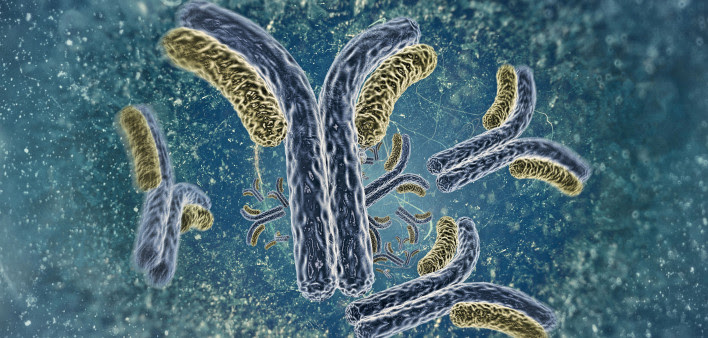
The new study will evaluate an approach known as germline targeting to train immature B cells in stages to produce broadly neutralizing antibodies against HIV. People with HIV produce antibodies against the virus, but these generally target highly variable parts of the virus, so they don't recognize new viral mutations. A small proportion of individuals naturally produce bnAbs that target hidden, conserved parts of the virus that don't change much. While most people have specialized B cells capable of producing bnAbs, they are few in number.
In a preliminary study, the eOD-GT8 60mer, an immunogen consisting of genetically engineered HIV envelope proteins, triggered the production of these rare immune cells—the first step in the pathway to generating bnAbs. Nearly all vaccine recipients (97%) produced the desired B cells, providing proof of concept that the approach could work. However, that study did not use mRNA technology, which is expected to accelerate the production of subsequent versions of the vaccine.
While the new vaccine approach looks promising, experts warn that HIV is much harder to prevent than SARS-CoV-2, in part because the immune system generally does not fight HIV naturally and does not confer lasting protection, as it does with the coronavirus.
In: https://www.poz.com/article/researchers-launch-trial-mrna-vaccines-hiv