
By Molly Walker, Associate Editor, MedPage
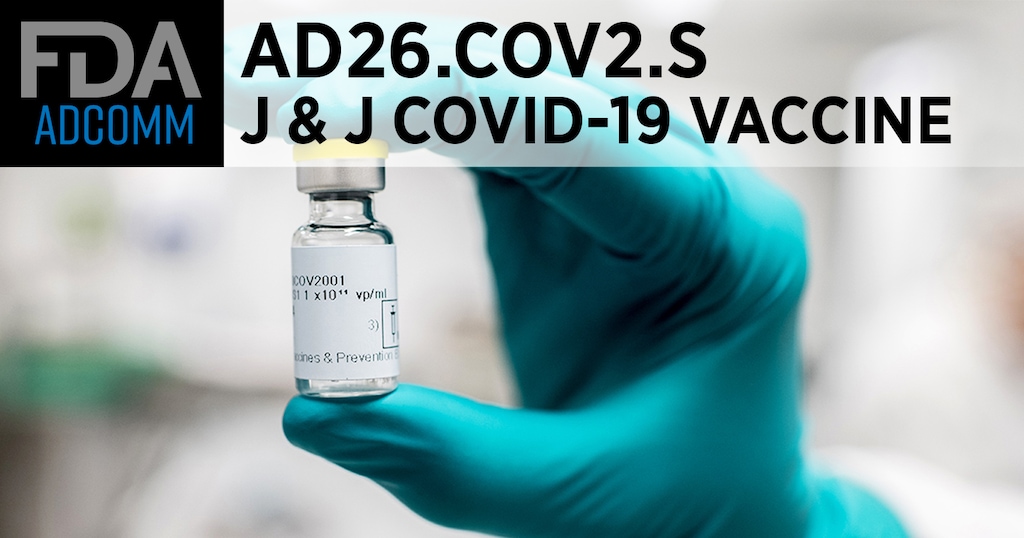
An FDA advisory committee voted unanimously on Friday to recommend the Johnson & Johnson COVID-19 vaccine (Ad26.COV2.S) for use in adults 18 years of age and older.
Based on all available scientific evidence, the FDA’s Vaccines and Related Biologicals Advisory Committee (VRBPAC) voted 22-0 that the vaccine’s benefits “outweigh its risks for use in people 18 years of age and older,” thus qualifying it for FDA Emergency Use Authorization (EUA). Most members emphasized the importance of obtaining another vaccine against the virus, given the growing number of variants that threaten to hinder progress against the pandemic.
“This was a relatively easy decision,” said Eric Rubin, MD, PhD, of the Harvard T.H. Chan School of Public Health in Boston and editor-in-chief of the New England Journal of Medicine. “It’s a little difficult to figure out how to use it clinically right now, but it still has a place.”
Some of the confusion may have stemmed from a presentation by Johnson & Johnson's Janssen Biotech division, which mentioned a two-dose study currently underway.
VRBPAC interim chairman Arnold Monto, MD, of the University of Michigan, suggested it was a question for the CDC's Advisory Committee on Immunization Practices, "especially if the two-dose formulation... appears to be more effective." The FDA panel could only review the vaccine as a one-dose regimen at Friday's meeting, as that was what Johnson & Johnson had requested.
The data supporting the current EUA application (the same data presented in the pre-meeting briefing documents) come primarily from the multinational, randomized, placebo-controlled, Phase III ENSEMBLE trial by Johnson & Johnson, sponsored in part by the National Institute of Allergy and Infectious Diseases. They showed efficacy of 66.9% (95% CI: 59.0%–73.4%) against moderate to severe COVID-19 at 14 days and 66.1% (95% CI: 55.0%–74.8%) at 28 days post-vaccination. Vaccine efficacy in the U.S. was 74.4% at 14 days post-vaccination and 72% at 28 days post-vaccination.
While the vaccine was mostly effective across all demographic groups, FDA technical staff noted that efficacy was lower among adults aged 60 and older with comorbidities than among healthier older adults. The two medically treated cases of COVID-19 in the vaccine group were among older adults with comorbidities.
Peter Marks, MD, PhD, director of the FDA's Center for Biologics Evaluation and Research, jumped into the discussion and asked if the committee was comfortable with the reduced efficacy in that group, since "people may be looking at that with a lot of scrutiny." However, the panel members objected, seeming satisfied with the explanation that the follow-up period was shorter for those participants and, as more cases accumulated, the product's efficacy for that subgroup would become clearer.
Another topic for the committee was how the manufacturer defined moderate to severe COVID-19, and David Kim, MD, an HHS official, addressed the issue initially raised at the open public hearing. He noted that the manufacturer defined “moderate” COVID-19 as two symptoms plus a positive PCR test, with “mild” COVID as one symptom plus a positive PCR test, leading to “a complete lack of mild COVID cases in the study.”
Kim said the manufacturer needed to be "consistent" with the definitions currently used by the FDA, the CDC and the other two vaccine manufacturers, and state that its claim that the vaccine's 67% effectiveness "applies to symptomatic COVID."
The efficacy against severe COVID-19 for the entire cohort was 76.7% (95% CI: 54.6%–89.1%) 14 days post-vaccination and 85.4% (95% CI: 54.2%–96.9%) at least 28 days post-vaccination. A post-hoc analysis found two COVID-related hospitalizations in the vaccine group and 29 in the placebo group after 14 days, with 0 and 16 cases after 28 days, respectively.
Despite a lower efficacy than the 95% claimed by Pfizer and Moderna, committee members wanted to make it clear that one vaccine was not better than the other. In fact, this vaccine offered its own advantages, and Ofer Levy, MD, PhD, of Boston Children's Hospital, pointed out that its 4°C storage temperature makes it a practical option for a variety of locations, including rural areas and globally.
Experience in children with Ad26 adenovirus platforms for other vaccines, such as for Ebola, could help bring a pediatric indication for J&J's COVID vaccine, Levy added.
When examining safety, pain at the injection site was the most common local adverse reaction in the vaccine group (49%), while headache (39%) and fatigue (38%) were the most common systemic reactions. As with other vaccines, younger participants reported these more frequently.
While confirmed cases of anaphylaxis were not reported in the informational documents, Janssen Biotech staff stated during the meeting that two cases of severe allergic reaction had occurred last week during an ongoing clinical trial in South Africa, including one case of anaphylaxis. These were still rare events, they emphasized.