

By Antonio Gutiérrez Pizarraya and María del Mar Tomás Carmona
On August 6, the U.S. Centers for Disease Control and Prevention issued a recommendation regarding the continued use of face masks indoors. This recommendation was based on a report indicating that vaccinated individuals had the same viral load in their upper respiratory tracts as unvaccinated individuals. Since then, the issue has generated considerable controversy. Some, in a display of fallacious and senseless recklessness, have seized upon this to claim that, if this is the case, the usefulness of vaccination is called into question.
The report that sparked the controversy
In it report from August 6thThe American agency presented a study conducted with data from the state of Massachusetts, analyzing 469 people who tested positive for COVID-19 in that state, 74% of whom were already vaccinated. The most controversial graph is shown below.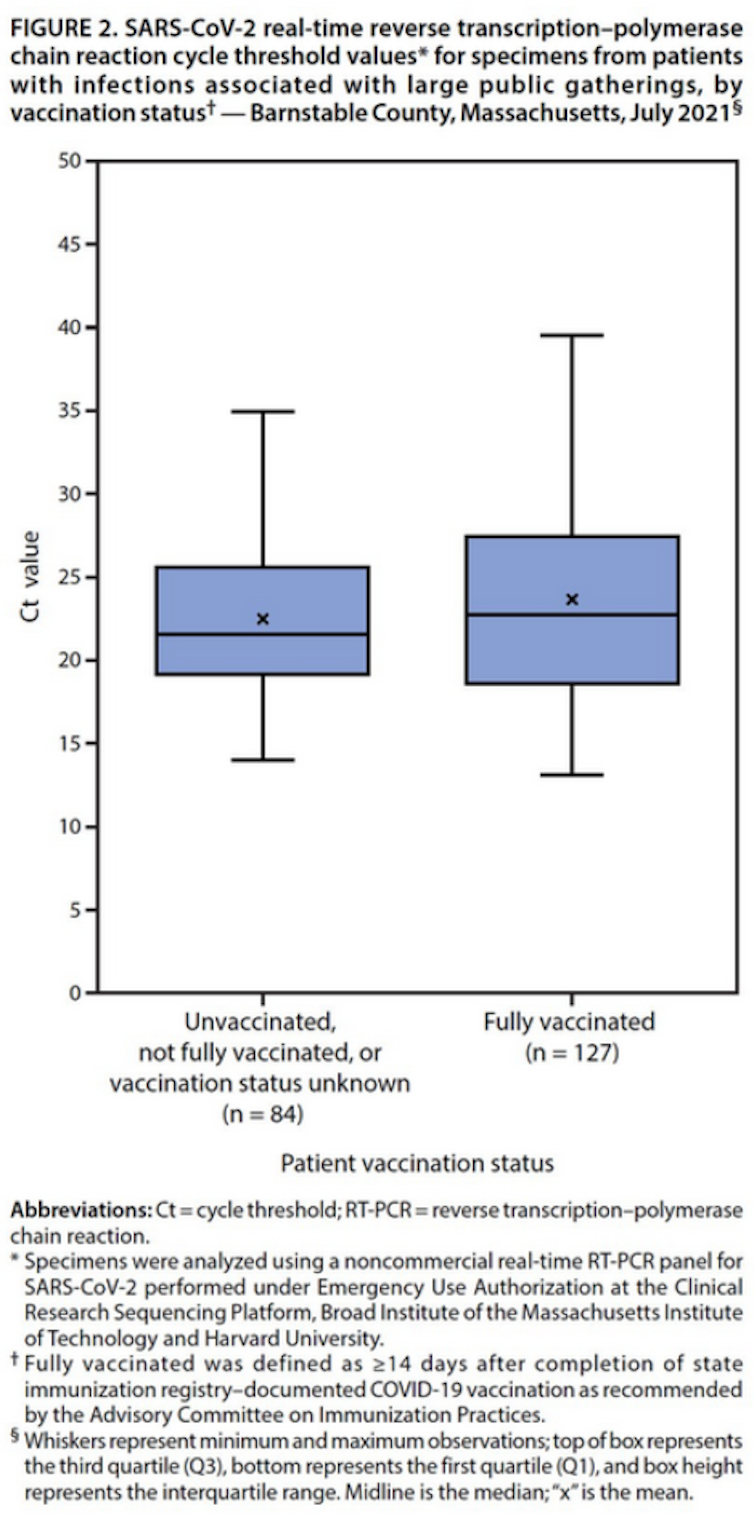 The study shows that the same amount of virus is detected in the throat and upper respiratory tract of the vaccinated group as in the unvaccinated group. In other words, they have similar amounts of viral RNA. The most immediate conclusion, and one that has been echoed by many media outlets, is that vaccinated people are just as contagious as unvaccinated people. This is not exactly the case.
Viral load and contagiousness
To date, molecular techniques for detecting viral RNA using RT-PCR technology and viral protein and antigen tests are the main methods for detecting the SARS-CoV-2 virus. Their primary objective is the diagnosis of infected patients. Both have limitations and advantages depending on their use, frequency, and the patient's status (symptomatic or asymptomatic). Regarding RT-PCR, several publications show that the Ct value, or relative viral load, at an individual level, cannot predict the transmissibility of the virus . On the other hand, the main limitation of antigen tests is the high percentage of false negatives (which could be even higher for variants) during the incubation period or presymptomatic stage of the infected patient, according to recent data .
A recent review analyzes whether RT-PCR and antigen tests can predict SARS-CoV-2 infectivity. Its conclusion is that, at present, neither of these techniques alone can predict a patient's contagiousness. Therefore, a clinical context related to symptoms and duration of illness is needed to inform decisions about discontinuing isolation in COVID-19 patients. Furthermore, a sensitive and rapid method for detecting the presence of the virus is needed to identify asymptomatic and presymptomatic individuals, who may have a low viral load but can still be infectious. Promising preliminary results have been obtained using molecular techniques with saliva samples .
Intramuscular and intranasal vaccines
Current vaccines, administered intramuscularly, act systemically. They train the body and provide it with instructions to generate defenses that protect us against possible future exposure to the virus, once it has already infected the person and penetrated the body. They are extraordinarily effective at preventing illness even if we acquire the virus; however, they are not designed to prevent infection altogether. Vaccines administered intranasally, such as the one being developed by the CSIC (Spanish National Research Council), use a different mechanism. These vaccines largely prevent infection. To do this, they facilitate the expression of a specific type of antibody called IgA. By administering the vaccine nasally, precisely at the virus's entry point—the oral and respiratory mucosa—these IgA antibodies are generated, neutralizing the pathogen just before it enters the body. This prevents infection. This does not theoretically occur with intramuscular vaccines because they act at a different level. We would greatly benefit from vaccines that completely block infection so that, once vaccinated, we are also unable to transmit it or, in other words, be contagious to others. This, to a greater or lesser extent (much less likely if we are vaccinated than if we are not), is already happening.
In China, the company CanSino has already published the results of its Phase I clinical trial of its aerosolized viral vector vaccine. But we shouldn't underestimate current vaccines. We already have preliminary data showing that even intramuscular vaccines generate IgA antibodies in saliva and oral mucosa, although these are more characteristic of intranasal vaccines, which are more focused on defending us at the point of entry of the virus. Is it true that vaccinated people can transmit the virus just as easily as unvaccinated people?
Although currently available vaccines were not initially designed to prevent infection, we now know that all of them have some degree of protection after the full course of vaccination. In a recent study by the Pasteur Institute, researchers estimated that unvaccinated individuals would have a risk approximately 12 times higher of transmitting the virus than those who have been vaccinated. In another study, conducted in the United States with 204 healthcare workers who were treating frontline patients and who tested positive, mRNA vaccines were highly effective in preventing SARS-CoV-2 infection. Only 5 cases were detected in fully vaccinated individuals, who showed a lower viral load, less severe symptoms, and shorter duration of illness compared to those who were partially vaccinated or unvaccinated. Along these lines, a study by Imperial College London (UK), in a scenario of a predominant delta variant, found that fully vaccinated individuals would have a 50-60% reduction in the risk of infection (even asymptomatic) compared to unvaccinated individuals. In Spain, a study conducted among healthcare and social care workers showed that vaccinated individuals experienced an 80-90% reduction in their risk of infection. Similarly, in the Netherlands, research analyzing the vaccine's effectiveness in preventing transmission between vaccinated individuals and close household contacts concluded that it showed an effectiveness against transmission of around 70%. In other words, fully vaccinated individuals are less contagious than those who are not vaccinated, and furthermore, according to data shared a few days ago, still pending peer review, vaccinated individuals eliminate the virus from their bodies much more quickly than unvaccinated individuals. This is true even in the presence of the predominant delta variant.
In other words, if you've been vaccinated, you'll be significantly less contagious to others than if you haven't. The virus clears from your body more quickly, even if your infection is from the delta virus.
What are the next steps?
In light of the observed results, it seems clear that current vaccines, despite not being designed for this purpose, are able to somewhat prevent the transmission of the virus between vaccinated individuals. There are discrepancies in the data, likely due to differences between the populations studied, circulating variants, vaccination prevalence, and other factors. The specific mechanisms behind this are unknown. One possibility is the presence of IgA in saliva and oral mucosa after administration, although we cannot be certain. Data is lacking to confirm this. In any case, our ability to reduce transmission among vaccinated individuals will help us control the pandemic more quickly, without diminishing the importance of other measures such as wearing masks indoors, ventilation, and other non-pharmaceutical interventions. Let us not forget that the measures we take are additive; their effects are cumulative. Despite the extraordinary usefulness of vaccines as a tool for controlling the pandemic, the overall vaccination rate still needs to increase. Let's not forget that we are at a stage of the pandemic where the delta variant, which is much more transmissible and whose dominance is driven primarily by its spread from asymptomatic and/or presymptomatic individuals, requires us to be vigilant and proactive. If we want to end this pandemic, we must provide access to vaccines to countries and regions that currently lack this possibility.