
By: Unaids.org
Press release
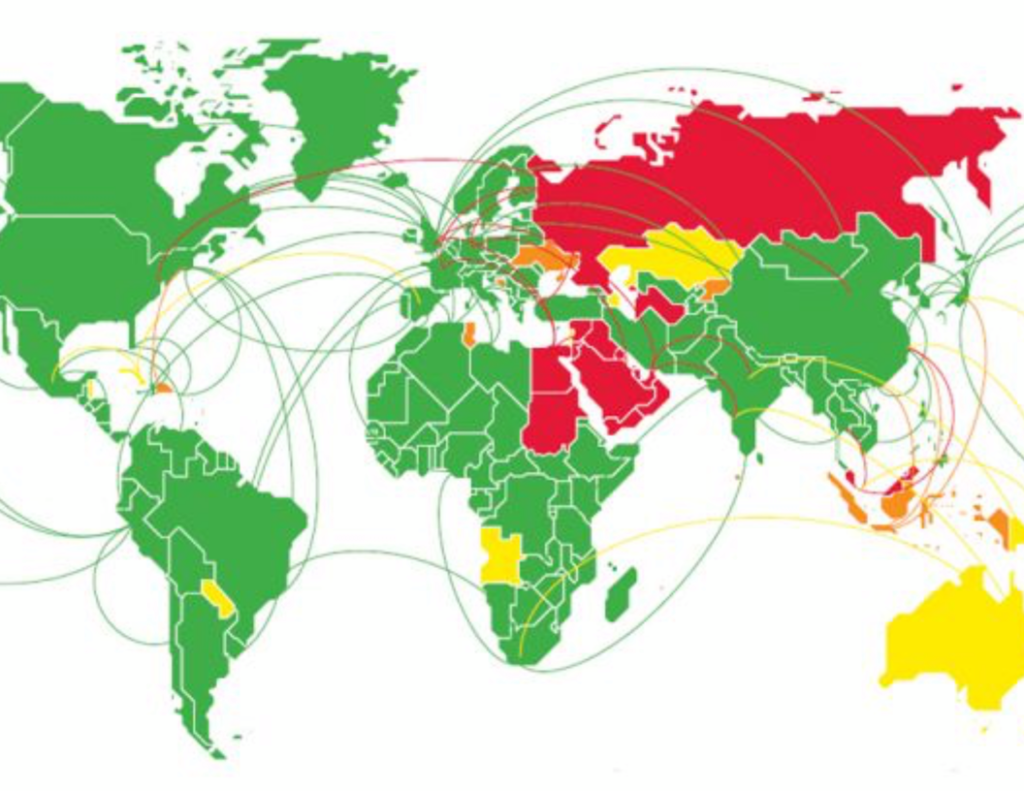
Recent data show that in 2019 some 48* countries and territories still maintain restrictions requiring mandatory HIV testing and declaration of serological status as part of the requirements for entry, residence, work and/or study permits
GENEVA, 27 June 2019— UNAIDS and the United Nations Development Programme (UNDP) urge countries to fulfill the pledges made in the 2016 UN Political Declaration to End AIDS by eliminating all HIV-related travel restrictions. Travel restrictions based on actual or perceived HIV status are discriminatory, prevent people from accessing HIV-related services, and perpetuate stigma and discrimination. Since 2015, four countries have made progress in eliminating HIV-related travel restrictions: Belarus, Lithuania, the Republic of Korea, and Uzbekistan.
“Travel restrictions based on HIV status violate human rights and are ineffective in achieving the public health goal of preventing HIV transmission,” said Gunilla Carlsson, Acting Executive Director of UNAIDS. “UNAIDS calls on all countries that still have HIV-related travel restrictions to eliminate them.”
“HIV-related travel restrictions fuel exclusion and intolerance by fostering the dangerous and false notion that travelers spread the disease,” said Mandeep Dhaliwal, UNDP Director for HIV, Health and Development Group. “The 2018 supplement to the Global Commission on HIV and Legislation was unequivocal in its findings that these policies are counterproductive to the effectiveness of the AIDS response.”
Of the 48 countries and territories that maintain restrictions, at least 30 continue to prohibit entry, stay, or residence based on HIV status, and 19 deport foreigners because of their HIV status. Other countries and territories may require HIV testing or diagnosis as a condition for obtaining a work or entry visa. Most of the countries with travel restrictions are concentrated in the Middle East and North Africa, but many countries in Asia, the Pacific, Eastern Europe, and Central Asia also impose restrictions.
“HIV-related travel restrictions violate human rights and increase stigma and discrimination. These restrictions do not reduce HIV transmission and are based on moral notions about people living with HIV and key population groups. It is truly incomprehensible that there are entry and residence restrictions related to HIV,” said Rico Gustav, Executive Director of the Global Network of People Living with HIV.
The Human Rights Council, meeting this week in Geneva, Switzerland, for its 41st session, has strongly called the attention of the international community to the importance of promoting human rights in the HIV response and has raised awareness about this, most recently in its resolution of 5 July 2018 on human rights in the context of HIV.
“Policies that use mandatory HIV testing to impose travel restrictions are not based on any scientific evidence, are detrimental to the enjoyment of human rights, and perpetuate discrimination and stigma,” said Dainius Pūras, Special Rapporteur on the right of everyone to the enjoyment of the highest attainable standard of health. “These policies are a direct barrier to accessing health care and are therefore ineffective in terms of public health. I call on States to eliminate discriminatory policies that require mandatory testing and impose travel restrictions based on HIV status.”
Recent information compiled by UNAIDS includes, for the first time, an analysis of the types of restrictions imposed by countries and territories, including cases where individuals are required to undergo testing to renew a residence permit. This information has been validated with Member States through their permanent missions to the United Nations.
UNAIDS and UNDP, as coordinators of the Joint Programme's work on human rights, stigma, and discrimination, are constantly working with partners, governments, and civil society organizations to change all laws that impose travel restrictions based on HIV status as part of the Global Partnership for Action to Eliminate All Forms of HIV-Related Stigma and Discrimination [hyperlink]. This is an alliance of UN Member States, UN entities, civil society, and the private and academic sectors to pool efforts in countries to implement and scale up programs and improve accountability to end HIV-related stigma and discrimination.
The 48 countries and territories that still maintain some type of HIV-related travel restriction are: Angola, Aruba, Australia, Azerbaijan, Bahrain, Belize, Bosnia and Herzegovina, Brunei Darussalam, Cayman Islands, Cook Islands, Cuba, Dominican Republic, Egypt, Indonesia, Iraq, Israel, Jordan, Kazakhstan, Kuwait, Kyrgyzstan, Lebanon, Malaysia, Maldives, Marshall Islands, Mauritius, New Zealand, Oman, Palau, Papua New Guinea, Paraguay, Qatar, Russian Federation, Saint Kitts and Nevis, Samoa, Saudi Arabia, Saint Vincent and the Grenadines, Singapore, Solomon Islands, Sudan, Syrian Arab Republic, Tonga, Tunisia, Turkmenistan, Turks and Caicos Islands, Tuvalu, Ukraine, United Arab Emirates, and Yemen.