- By Veronica Smink
- BBC News Mundo
A series of clinical trials in various parts of the world are investigating the effects of combining different coronavirus vaccines.
The world is making rapid progress in its fight against the coronavirus, with nearly 4.7 billion doses of vaccines administered around the globe so far this year, according to figures compiled by the NGO Our World in Data.
The race to immunize against Covid-19 began on the last day of 2020 - exactly one year after the emergence of this virus - when the World Health Organization (WHO) gave its first emergency authorization to the American Pfizer-BioNTech vaccine.
At this point in the year, just over 30% of the world's population has already been vaccinated with at least one dose of the various inoculations that have emerged, and 23% of the planet's inhabitants have completed their immunization.
However, according to the WHO, in low-income countries, only 1.2% of people were inoculated with a dose.
In addition to the inequality of resources to purchase vaccines, another obstacle to global immunization has been the series of problems faced by vaccine manufacturers.
From fears of adverse side effects, which led some countries to limit the use of certain vaccines, to difficulties in producing inoculations due to the global shortage of supplies, which have caused serious delays in delivery.
A partial solution to these problems that several countries have tried is to combine different vaccines.
Most COVID-19 vaccines require two doses (with the exception of the Janssen vaccine, manufactured by Johnson & Johnson, and the Russian Sputnik Light vaccine, which use only one).
And except for Sputnik V, which uses two different components, both doses are the same.
This has led various nations to investigate possible combinations.
Heterologous vaccination—its scientific name —is nothing new . Mixing vaccines began in the 1990s to combat another virus: HIV, which causes AIDS.
Research conducted so far with some COVID-19 vaccines has shown that swapping them is not only possible, but in many cases even advisable .
According to these studies, combining them would not only give a significant boost to the global vaccination effort, but could also offer better protection against the coronavirus.
What is known so far?
Perhaps the most studied vaccine in combination with others is the AstraZeneca vaccine, also known as AZ.
The researchers at Oxford University, who created the inoculation, have been investigating the effectiveness of this vaccine when used in tandem with others since February 2020.
The appearance of blood clots in a small number of people inoculated with this vaccine led several countries, which had already administered the first dose to hundreds of thousands of citizens, to decide not to use the second dose for certain age groups.
This accelerated the need to combine the British vaccine with others.
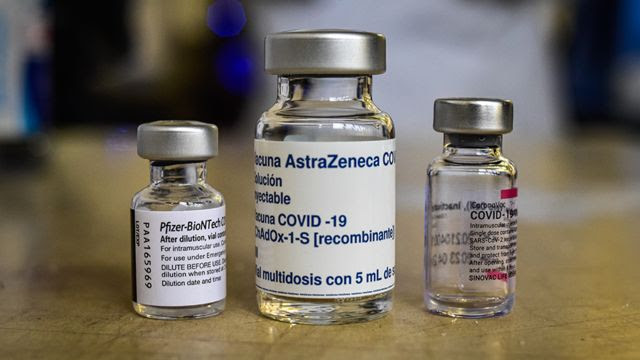
The first Oxford University study, known as "Com-COV1", studied the effects of combining AZ with Pfizer in 850 volunteers over 50 years of age.
These vaccines use two different platforms to fight the virus.
The AZ uses a viral vector: an attenuated chimpanzee adenovirus, which contains genes from the coronavirus.
Pfizer, on the other hand, uses a novel method called messenger RNA (or mRNA). This technique injects part of the coronavirus's genetic code into the body.
Results
The preliminary results of the Com-COV1 study, published at the end of June, were highly promising.
It was found that combining a first dose of AZ and a second dose of Pfizer generated more antibodies and T cells (the immune cells that kill pathogens) than using two components of AZ.
Also, using Pfizer first and then AZ was more beneficial than using the British vaccine twice (although not as effective as using them in reverse order).
Although trials showed that using two doses of Pfizer generated the highest number of antibodies, using the British vaccine first and then the American one resulted in a stronger T-cell response, which is key to fighting an infection.
Other countries that conducted their own tests reached similar conclusions.
Even before the results were known in the United Kingdom, Spain had already begun combining AZ with Pfizer, after the preliminary conclusions of phase 2 of the CombiVacs study, carried out by the Carlos III Health Institute, published in May, also showed the effectiveness of this mixture.
The Spanish trial, which involved 676 people aged between 18 and 59 who had received a first dose of AZ, concluded that, with a second dose of Pfizer, the antibodies were more than double those obtained with two doses of AZ.
While the second dose – also called the booster – usually multiplies antibodies by three when AZ is applied twice, if Pfizer is used as the second component, the multiplication is by seven, the Spanish study showed.
At the end of July, another clinical trial investigating the AZ-Pfizer combination, this time in South Korea, confirmed the benefits of this mixture.
The study, which included 499 health workers, concluded that combining AZ with Pfizer generated levels six times higher than using two doses of AZ.