
by Westmead Institute for Medical Research https://medicalxpress.com/news/2019-06-newly-immune-cells-frontline-hiv.html
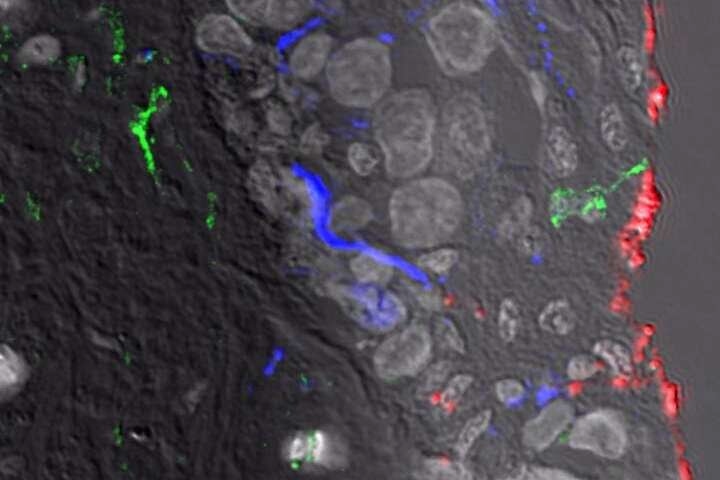
Researchers at the Westmead Institute of Medical Research have discovered new immune system cells that are on the front lines of HIV infection. Known as CD11c+ dendritic cells, these new cells are more susceptible to HIV infection and can then transmit the virus to other cells.
CD11c+ dendritic cells are a subset of dendritic cells found only in human genital tissues, specifically in the epithelial layer of the vagina, the inner foreskin, and the anus. This location in genital tissue often means that these CD11c+ dendritic cells are the first to interact with HIV.
One of the lead researchers on this project, Associate Professor Andrew Harman of the Westmead Institute for Medical Research, says the role of these cells is to capture any viruses and then deliver them to CD4 T cells.
"CD4 T cells are responsible for driving an immune response . Interestingly, they are also the main target cells of HIV, in which the virus replicates."
"Once dendritic cells capture a pathogen, they communicate what they have found to CD4 T cells in the lymph nodes. This information prepares the immune system to either tolerate a bacterium or virus, or attack it."
"However, if CD4 T cells fall below critical levels (for example, in HIV-positive patients), the body is no longer able to develop an immune response, leading to an AIDS diagnosis."
"Our research team has shown that CD11c+ dendritic cells are more susceptible to HIV infection than any other known dendritic cell. We have also shown that these cells interact with CD4 T cells more efficiently than any other dendritic cell. These cells transfer the virus to CD4 T cells, making them key drivers of HIV infection."
According to co-author and chief executive of the Westmead Institute for Medical Research, Professor Tony Cunningham, this discovery has opened up two new lines of research
"This discovery opens a door to developing strategies to block HIV transmission. If we can block HIV's ability to bind to CD11+ c dendritic cells, which are often the first immune cells to encounter the HIV virus, then we can stop its ability to transmit the virus to CD4 T cells. In a situation where CD4 T cell levels are low, this could prevent the virus from spreading."
“Another avenue is to use this new information to develop an HIV vaccine. If HIV fragments or inactivated HIV were targeted at these CD11+ c dendritic cells, this could trigger an immune response against HIV as soon as it enters the body,” says Professor Cunningham.
This research finding is published in Nature Communications