
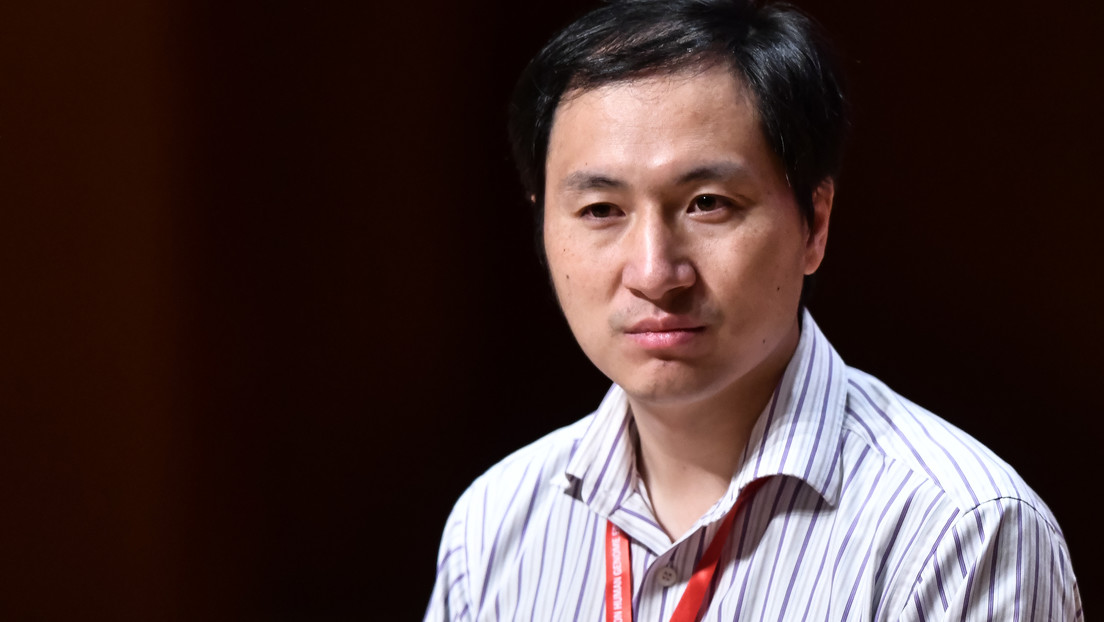
The scientist, who genetically modified the embryos of two twins who were in the gestation stage, admitted that they may present unforeseen mutations.
A Chinese court on Monday sentenced He Jiankui, the scientist who in 2018 announced the creation of the world's first 'genetically edited' babies, to three years in prison and a fine of 3 million yuan (about $430,000), Xinhua reports.
A court in the city of Shenzhen (Guangdong province) in its ruling also highlighted the high degree of social danger of He Jiankui's experiment, which it described as an "illegal act".
In November 2018, the scientist announced that he had used the gene-editing technology known as CRISPR-Cas9 to change the genes of twin girls who were in the gestational stage and who, according to several sources, would have been born that same month or in October.
The twins Lulu and Nana were born as a result of an experiment carried out by a team led by He Jiankui, a researcher at the Southern University of Science and Technology in Shenzhen, who manipulated the genome of the embryos to give them immunity to HIV infection .
This news made headlines worldwide, as it would be the first case of its kind in history. He Jiankui attempted to have the study accepted by Nature and the Journal of the American Medical Association (JAMA), but his work was immediately questioned by the scientific community and has not been published by those or other journals.
https://www.youtube.com/watch?time_continue=1&v=TqjuOwqoA08&feature=emb_title
Irregularities in the experiment
This month He Jiankui acknowledged that babies could have unforeseen mutations.
Furthermore, after the release of the original text, several irregularities in the experiment came to light, including the possibility that portions of the genome may have been damaged during the application of the CRISPR/Cas9 technology, used to selectively modify DNA.
Specifically, after using this 'molecular scissors', the team found that one of the embryos presented a "possible mutation" in a chromosome that was not part of the objective of the experiment, but estimated the error as not significant.
"This potential out-of-range mutation was at least 279 kb away from any known gene," the manuscript states. "So we conclude that this out-of-range intergenic genomic insertion might not impact any biological function ," it adds.
In February 2019, an investigation found that the experiment conducted by He Jiankui and his team may have accidentally improved the twins' cognition, learning, and memory, but another study published in June of that year found that their life expectancy would have been reduced by 21% due to the genetic manipulation.
On July 26, the WHO released a statement calling for a ban on the creation of genetically modified babies. According to the organization's Director-General, Dr. Tedros Adhanom Ghebreyesus, this "poses unique and unprecedented ethical and technical challenges."
Source: RT News