
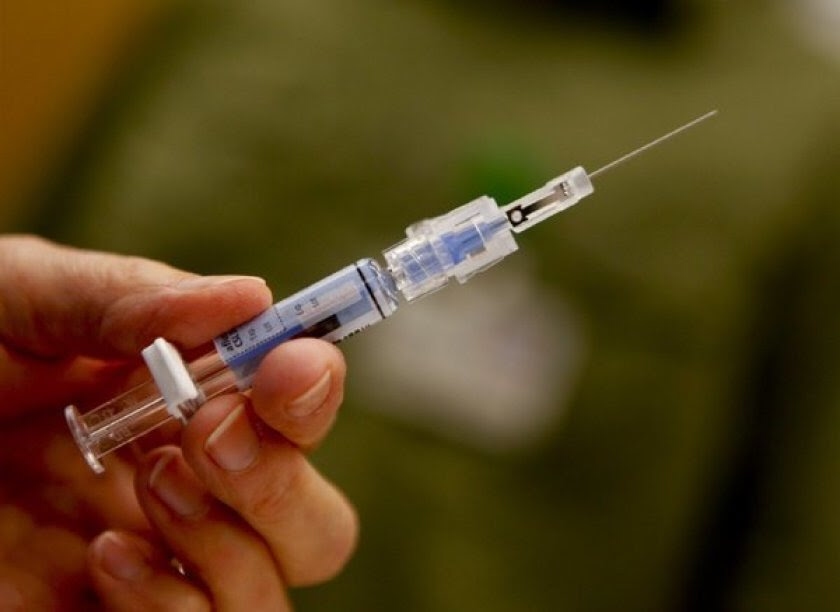
After decades of research, scientists are cautiously optimistic about the prospects for an HIV vaccine. (Mark Boster / Los Angeles Times)
EMILY BAUMGAERTNER, EDITOR
September 6, 2019, 6 AM
First there were medications that could push HIV back to undetectable levels, and the virus was no longer a death sentence. Then came treatment that allowed HIV-negative people to remain that way, even if their partners were not.
But to truly defeat the virus that causes AIDS, doctors need a vaccine. And after decades of dead ends and dashed hopes, they may finally be on the verge of having one.
With the launch of a large-scale clinical trial this fall and several others underway, scientists say they are cautiously optimistic that they will soon have a way to combat HIV long before a person is exposed.
“When you have a disease that is transmitted without symptoms, you will contract it when you least expect it,” said Dr. Larry Corey, principal investigator of the HIV Vaccine Trials Network. In such situations, “the only baseline control measure that has been shown to be effective is a vaccine.”
Researchers and public health experts agree that the surest way to eliminate a disease for good is through vaccination. It worked for smallpox. It worked for polio. And, when combined with antiretroviral therapy and pre-exposure prophylaxis, it could work for HIV, too.
A vaccine would mean "the end of the AIDS story as we know it," said Dr. Robert C. Gallo, director of the Institute of Human Virology at the University of Maryland School of Medicine.
More than 37 million people worldwide are living with HIV, and they transmit it to about 5,000 people every day, Corey said. There are also approximately 180,000 transmissions to newborns each year.
"Unfortunately, this virus is doing very well," he said.
The human immunodeficiency virus (HIV) attacks a specific type of white blood cell that the body relies on to fight infections. If left untreated for several years, a patient's white blood cell count becomes critically low, leading to acquired immunodeficiency syndrome (AIDS). This makes the body vulnerable to bacteria and fungi that can cause tuberculosis, meningitis, certain types of cancer, and other serious illnesses that can lead to death.
Once Gallo and other scientists identified HIV as the cause of AIDS in 1984, it didn't take them long to recognize the need to inoculate people against the virus. Even then, he said, "we were already planning a vaccine."
Vaccines prepare the immune system for a dangerous invader by introducing a dead or weakened version of it. That way, if the real threat appears later, the body is already equipped to recognize and defeat it.
With classic threats like measles or polio, the vast majority of people can already suppress the virus and eradicate it from their bodies. In those cases, developing a vaccine is as simple as finding a safe way to mimic a natural infection, perhaps by introducing a modified version that has been stripped of its weaponry.
But HIV is different, because no patient has ever been known to overcome the virus on their own.
This means that scientists working on a vaccine don't have a natural cheat sheet at their disposal. It also means that a successful vaccine will have to work very hard to achieve its goal.
“If we want to make a long-lasting vaccine, we need to be even smarter than we were about natural infection. We’ve never had that challenge with any other virus,” said Dr. Anthony S. Fauci, director of the National Institute of Allergy and Infectious Diseases. “I don’t think it’s impossible. But we have to understand the relationship between the pathogen and the immune system in a way we’ve never had to before.”
HIV is a cunning opponent. The virus not only defends itself against attacks from immune cells, it invades them, integrating itself into the victim's DNA. It can also wrap itself in sugar molecules to prevent antibodies from attaching to its shell.
Then there are genetic complications. HIV has more genetic diversity than any other known virus. It makes frequent mistakes while replicating, and can survive without correcting them. This ability to mutate rapidly makes it a moving target: it's no match for a vaccine designed to protect against a single strain.
In addition, there are different HIV subtypes in different parts of the world. (Subtype B is common in North America and Europe, for example, while subtype C is found in southern and eastern Africa.) An effective vaccine must be based on components derived from a mosaic of HIV variants to work against many strains.
"We need to protect ourselves against all that variability," said Dr. Susan Buchbinder, director of Bridge HIV, a prevention research unit at the San Francisco Department of Public Health.
That strategy will be tested this fall in a large-scale efficacy trial called Mosaico. The experimental vaccine, made by Johnson & Johnson, contains a series of genetic sequences from several strains of HIV.
In preclinical trials, the vaccine effectively protected approximately 66% of non-human primates against HIV-like viruses. Follow-up studies in humans helped finalize its composition.
Scientists now plan to enroll approximately 3,800 healthy participants at more than 50 trial sites in North and South America and Europe. All participants will come from groups at high risk of HIV infection, including men who have sex with men and transgender people. They will receive four vaccines over the course of a year.
The study will be double-blind, meaning that neither the participants nor the researchers will know who has been randomly selected to receive the experimental vaccine and who is receiving a placebo. If the vaccine is successful, researchers hope it will be used worldwide.
"We are really excited about this one," said Buchbinder, the chairman of the protocol for Mosaico's trial.
Focusing on high-risk populations is paramount, researchers say. Men who have sex with men account for nearly two-thirds of new HIV infections in the United States. And the world’s approximately 25 million transgender people are almost 50 times more likely to be living with HIV than the general population.
As part of the study enrollment process, researchers will educate volunteers about the benefits of pre-exposure prophylaxis (PrEP) and encourage them to take that medication instead of joining the study. Only those who say they still want to forgo the treatment will be allowed to participate.
Other trials are already underway. In sub-Saharan Africa, a similar vaccine is being tested on 2,600 women, the highest-risk group in that region. That trial began in 2017, and the results will not be available until 2021 at the earliest.
Two parallel studies that began in 2016 aim to evaluate whether infusions of a broadly neutralizing antibody can prevent a person from contracting HIV and, if so, what levels are needed to maintain that protection. Laboratory studies have shown that these antibodies prevent up to 90% of HIV strains from infecting human cells. These trials are being conducted in sub-Saharan Africa and North and South America.
Another ongoing clinical trial in South Africa is testing an improved version of a vaccine that was the first to show even limited efficacy against HIV. That vaccine provided sustained protection in about a third of those tested in a landmark 2009 study in Thailand.
“It wasn’t good enough for prime time, but it helped us,” Fauci said. He said experts decided against rolling out the vaccine, in part because it could lead people to believe they are immune to HIV when they are actually only partially protected.
No vaccine is foolproof, and scientists say they don't have to be. Researchers from the International AIDS Vaccine Initiative determined that a vaccine that is 70% effective would do more to prevent new infections than PrEP.
The Mosaic trial is pushing to achieve 65% effectiveness, Buchbinder said. "Even a more modestly effective vaccine could alter the course of the epidemic," he said.
Many other vaccine candidates are in development. Gallo and his colleagues are working on their own HIV vaccine, which they hope will enter a phase II trial to test its effectiveness in the near future.
“Clearly we’ve had our ups and downs, but science is about testing our hypotheses, even if the result is ‘No, it definitely doesn’t work,’” Buchbinder said. “The only failed experiment is one where you don’t find an answer to your question.”
From: https://www.latimes.com/science/story/2019-09-05/hiv-vaccine