
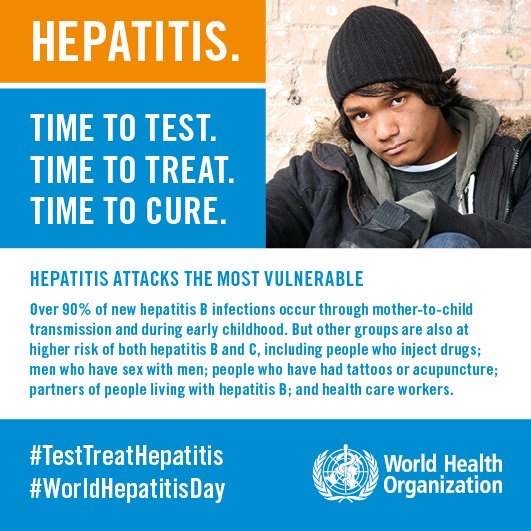
Geneva, July 26, 2019 (PAHO/WHO) - Ahead of World Hepatitis Day (July 28), the World Health Organization (WHO) is calling on countries to take advantage of recent reductions in the costs of diagnosing and treating viral hepatitis by increasing investments to eliminate the disease.
A new WHO study, published today in Lancet Global Health, found that investing US$6 billion per year in eliminating hepatitis in 67 low- and middle-income countries would prevent 4.5 million premature deaths by 2030, and more than 26 million deaths beyond that target.
A total of US$58.7 billion is needed to eliminate viral hepatitis as a public health threat in these 67 countries by 2030. This means reducing new hepatitis infections by 90% and deaths by 65%.
“Currently, 80% of people living with hepatitis cannot access the services they need to prevent, diagnose, and treat the disease,” said WHO Director-General Dr. Tedros Adhanom Ghebreyesus. “On World Hepatitis Day, we call for bold political leadership, with investments to match the gap. We urge all countries to integrate hepatitis services into benefits packages as part of their journey toward universal health coverage.”
By investing now in diagnostic tests and medicines to treat hepatitis B and C, countries can save lives and reduce the costs associated with long-term care for cirrhosis and liver cancer that result from untreated hepatitis.
Some countries are already taking action. Three countries in the Americas have set the goal of eliminating hepatitis as a public health problem by 2030, and to achieve this, they are working to reduce the prices of key antiviral medications. The Pan American Health Organization's (PAHO) Strategic Fund for Medicines has options available for treating hepatitis C. In addition to existing combination therapy, the Fund is including WHO-prequalified generic antivirals, available to countries in the region that can purchase the generic version of the treatment.
In the Americas, approximately 3.9 million people live with hepatitis B and another 7.2 million with hepatitis C, while roughly 125,000 died from viral hepatitis in 2013. Nearly 96% of these viral hepatitis deaths result from chronic hepatitis B and C infections, which can lead to cirrhosis and primary liver cancer, or hepatocellular carcinoma. Antiviral medications for hepatitis B and C can reduce the risk of developing liver cancer by 75%. In 2016, approximately 14% of people with hepatitis C had been diagnosed, while less than 1% had received treatment in Latin America and the Caribbean.
“No one should die from hepatitis. We have the tools to save lives: a cure for hepatitis C and effective treatment for hepatitis B. There is no doubt that childhood vaccination against hepatitis B in the Americas has been substantially successful and will save millions of lives. But it is not enough. Immunization cannot help those already infected with hepatitis B, and there is no vaccine for hepatitis C,” said Marcos Espinal, Director of Communicable Diseases and Environmental Determinants of Health at PAHO.
“Cases of hepatitis C can now be cured in just three months, and this saves lives. However, treatment remains unaffordable or inaccessible for most of the region. We need urgent investment from ministries to expand diagnosis and treatment now to achieve the goal of eliminating hepatitis as a public health problem in the Americas by 2030,” he added.
Without access to prevention, testing, and treatment for most
For the vast majority of the 325 million people living with hepatitis B and/or C, access to testing and treatment remains out of reach. In the Americas, approximately 11 million people live with hepatitis B and/or C.
Of the estimated 257 million people living with hepatitis B infection:
• 10.5% (27 million) knew their infection status in 2016. In the Americas, 1.5 million (14%) knew their status.
• Of those diagnosed worldwide, only 17% (4.5 million) received treatment in 2016.
• In 2016, 1.1 million people (11,000 in the Americas) developed chronic hepatitis B infection, a leading cause of liver cancer.
Of the approximately 71 million people living with chronic hepatitis C in 2015.
• 19% (13.1 million) knew their infection status in 2017.
• Of those diagnosed, 15% (2 million) received curative treatment that same year. Overall, between 2014 and 2017, 5 million people received curative treatment for hepatitis C.
• In 2017, 1.75 million people newly developed chronic hepatitis C infection.
• In the Americas, in 2016, of the approximately 7.2 million people living with chronic hepatitis, 600,000 knew their infection status and 65,000 developed chronic hepatitis C infection.
World Hepatitis Day
The WHO's global hepatitis strategy, supported by all Member States, aims to reduce new hepatitis infections by 90% and deaths by 65% between 2016 and 2030.
On World Hepatitis Day 2019, the WHO is calling on all countries to “Invest in eliminating hepatitis” by budgeting for and funding elimination services within their universal health coverage plans. While there has been broad support among WHO Member States for adopting the WHO strategy for the elimination of hepatitis, with 124 (17 of which are in the Americas) of 194 countries developing hepatitis plans, more than 40% of national plans lack specific budget lines to support elimination efforts.
The WHO has also launched online calculators (www.hepccalculator.org and www.hepbcalculator.org) designed to help decision-makers assess the cost-effectiveness of their hepatitis treatment programs.
There are five types of viral hepatitis infections: A, B, C, D, and E. More than 95% of deaths are caused by chronic hepatitis B and C infections, while hepatitis A and E rarely cause life-threatening illness. Hepatitis D is an additional infection that occurs in people living with hepatitis B.
WHO campaign for World Hepatitis Day 2019: https://www.who.int/campaigns/world-hepatitis-day/2019.
SDG Health Price Tag
In 2017, the SDG Health Price Tag study estimated the investments needed to achieve 16 health-related Sustainable Development Goal targets in 67 low- and middle-income countries, including 7 countries in the Americas, representing 75% of the world's population. This study did not include the cost of hepatitis.
The new study published today is based on the same scenarios and modeling methods to estimate the costs of achieving global hepatitis elimination goals.
From: https://www.paho.org/hq/index.php?option=com_content&view=article&id=15337:who-urges-countries-to-invest-in-eliminating-hepatitis&Itemid=1926&lang=es