
From the University of North Carolina, the University of Washington, the Martin Delaney Collaboratory based at Fred Hutch, and the Division of Vaccines and Infectious Diseases.
AUGUST 19, 2019 • BY BRIANNA TRAXINGER
Antiretroviral therapy (ART) is highly successful in controlling HIV and preventing progression to AIDS, but ART does not eliminate latent viral reservoirs, which recover after ART is discontinued. Research into a cure for HIV currently focuses on multiple strategies, including cell and gene therapy (C>). This approach involves transferring genetic material or cells into a patient to encourage their own immune system to kill HIV-infected cells or make cells resistant to HIV infection. Most C> studies have not progressed beyond preclinical development, but some are currently being tested in people living with HIV (PLWH); however, these studies are too preliminary to directly benefit study participants. Therefore, attitudes toward C> in HIV-positive communities are important factors in considering C> as a feasible HIV cure strategy, especially in the African American population, which bears a disproportionately high HIV burden. The Community Advisory Board (CAB) of derrotHIV identified that an assessment of these attitudes is of great importance to both researchers and the community. To understand and integrate PLWH perspectives regarding C> in biomedical research, Karine Dubé of the University of North Carolina, along with the Fred Hutch Division of Vaccines and Infectious Diseases, derrotHIV, and the UW Department of Psychology, conducted focus group discussions (FGDs) with PLWH in the Seattle area and published their findings in AIDS and Human Retrovirus Research.
Following the principles of community-based participatory research, the authors worked with the derrotHIV CAB in December 2017 to conduct forward-looking data collection (FGD) interviews to solicit attitudes, feelings, and beliefs of people living with HIV (PLWH) regarding contraception relevant to future clinical trial recruitment and practices. A total of 19 HIV-positive participants were enrolled, and African Americans, as well as men who have sex with men, were deliberately oversampled, as both groups bear disproportionately high burdens of HIV infection. Dr. Simoni conducted the FGD interviews by inquiring about prior knowledge and experience with HIV and contraception clinical research, providing a description of contraception and its uses in HIV, gathering initial reactions and concerns about proposed treatments, and asking about participants' understanding of the risks and benefits.
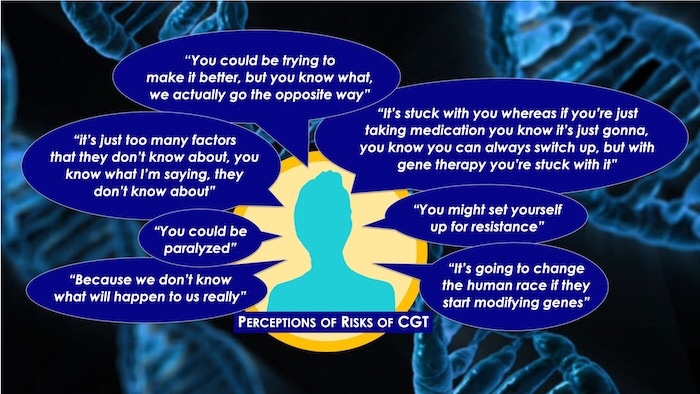
Focus group discussions with people living with HIV in the Seattle area revealed that participants were concerned about C> treatment for HIV eradication and shared the C>-related fears shown above.
Figure provided by Michael Louella.
The authors found that none of the participants had heard of C>, and once introduced to it, most participants were wary of the strategy, their apprehension based primarily on fears of receiving injected material and gene manipulation. Furthermore, many felt that the risks of C> would outweigh the benefits, as many of the participants currently lead normal, healthy lives on ART and would prefer not to interfere with their stable treatment regimen, especially since C> would require discontinuing ART. Additional concerns centered on the long-term, unintended side effects of C>, its irreversibility, and worries that physical appearance would change or offspring would inherit genetic alterations. However, some participants expressed hope and potential interest in C> and GT if more information about the treatment were provided, allowing people to weigh the risks and benefits. Those curious about C> noted that they would like to speak with people who had undergone the procedure or received approval from their HIV care physicians before considering C>. In general, people living with HIV (PLHIV) were cautious regarding the use of C> as an investigated strategy to cure HIV infection. These findings highlight the importance of conducting behavioral research and incorporating diverse community perspectives when designing new HIV clinical trials.
This study is the first to qualitatively assess preconceptions, concerns, and acceptance of C> in PLWH. This work focused on populations that are often excluded from or lack access to medical research, scientific knowledge, and participation in clinical trials, and found that a low percentage of this relevant demographic would be willing to undergo C>. Dubé expanded on these findings, saying the authors “believe that the perspectives of people living with HIV should be paramount in planning future research efforts.” She hopes that social science research “will open an important dialogue on essential considerations for engaging communities in the early stages of HIV cure science, as well as future research priorities.”
This work was supported by the Martin Delaney derrotHIV Collaboratory and the University of Washington/Fred Hutch AIDS Research Center.
Dubé K, Simoni J, Louella M, Sylla L, Mohamed ZH, Patel H, Luter S, Collier AC. 2019. Acceptability of cell and gene therapy to cure HIV infection among people living with HIV in the northwestern United States: a qualitative study. AIDS Res Hum Retrovirus. doi: 10.1089/AID.2019.0021. Epub 2019 May 21.
From: https://www.fredhutch.org/en/news/spotlight/2019/08/dube_vidd_