
Liz HighleymanJuly 24, 2019
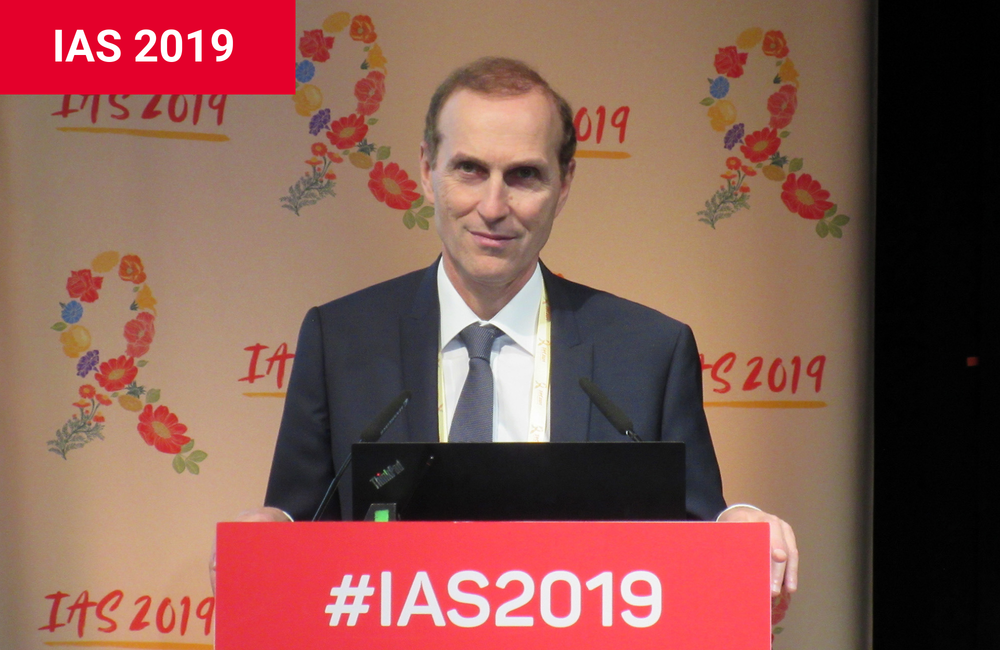
Jean-Michel Molina at IAS 2019. Photo by Liz Highleyman.
The World Health Organization (WHO) has updated its pre-exposure prophylaxis (PrEP) recommendation to include event-driven PrEP taken before and after sex, also called on-demand PrEP or the 2+1+1 regimen, as an HIV prevention option for men who have sex with men.
The update was announced at the 10th International AIDS Society Conference on HIV Science (NIC 2019) in Mexico City. The conference included numerous presentations on PrEP, including a report indicating that no participant in the French Prévenir study who consistently used daily or event-targeted PrEP acquired HIV.
Event-driven PrEP involves taking a double dose (two pills) of Truvada (tenofovir disoproxil fumarate/emtricitabine) between 2 and 24 hours before sexual intercourse, and then, if sex occurs, one pill 24 hours after the double dose and another 24 hours after that. If sex occurs on several consecutive days, one pill should be taken each day until 48 hours after the last event.
In 2015, Dr. Jean-Michel Molina, from the University of Paris, reported that event-directed PrEP reduces the risk of HIV infection by 86% among gay and bisexual men in the French Ipergay study – matching the protective effect of daily pre-exposure prophylaxis in the UK PROUD study.
Following Ipergay, Molina's group embarked on the Prévenir study, which aims to demonstrate that enrolling 3,000 additional men in the Paris region on PrEP would lead to a 15% reduction in HIV diagnoses among men who have sex with men. Study participants could choose to take Truvada daily or on a schedule based on their sexual activity, and could switch regimens during the study.
At last year's International AIDS Conference in Amsterdam, Molina reported that no new HIV infections had occurred among men taking any of the PrEP regimens. Yesterday, he presented an update showing that PrEP remains effective with longer follow-up.
By early May 2019, Prévenir had enrolled 3,057 men at 26 sites, exceeding its original target. Almost all were men who have sex with men, but 30 self-identified heterosexuals and 13 transgender individuals were also included. The majority (85%) were white, and the median age was 36. More than half of the participants did not have a regular sexual partner. They had a median of 10 sexual partners in the past three months and a median of two acts of unprotected sex in the past month. Fourteen percent reported using sexual drugs or recreational drugs the last time they had sex.
About half of the men opted for event-driven PrEP, and this proportion remained constant throughout the 18-month follow-up. About 15% switched regimens, with an equal number switching from daily to intermittent and from intermittent to daily doses.
Nearly all men (97%) in the daily PrEP arm, but only 82% in the event-driven arm, said they had taken PrEP as prescribed the last time they had sex. The most common reason for not taking PrEP was feeling that sex was low-risk. About 20% in both groups reported using condoms the last time they had sex.
Two men seroconverted during follow-up, both in the event-driven group, for an HIV incidence rate of 0.09 per 100 person-years. The incidence was very low in both groups: 0 and 0.2 per 100 person-years, respectively, among those taking daily and intermittent PrEP. Molina estimated that PrEP use had prevented 143 new HIV infections.
Both men who had seroconverted had stopped taking PrEP several weeks prior and had engaged in unprotected sex in the meantime. One man, 52 years old, started PrEP on demand in April 2016 and enrolled in Prévenir in February 2018. The other, 47 years old, started daily PrEP in June 2016 but switched to intermittent dosing when he joined Prévenir in June 2017. Neither showed evidence of drug resistance to Truvada.
The number of sexual acts and the number of sexual partners were higher among daily PrEP users compared to intermittent users. In both groups, the frequency of sex increased by 43% after starting PrEP, but then stabilized. Conversely, the number of sexual partners decreased by 20% after starting PrEP.
Molina reported that bacterial sexually transmitted infections (STIs) were common, with a 38% increase from baseline to month 18. The overall incidence rate was 86 per 100 person-years. STIs were more common in the daily PrEP arm at both baseline and at 18 months. He also said that nine men in the daily PrEP group and 11 in the intermittent PrEP group contracted hepatitis C virus during follow-up. He noted that the viral hepatitis incidence rate of 1.04 per 100 person-years, which included one case each of hepatitis A, B, and E, was quite high, and the researchers were working to address this issue.
Both daily and event-based PrEP were well tolerated. Drug-related adverse events were infrequent and similar in both groups. Only three people discontinued Truvada due to gastrointestinal side effects.
Molina was part of the group that developed the WHO technical report on event-driven PrEP.
In 2015, the WHO recommended that oral PrEP "should be offered as an additional prevention option for people at substantial risk of HIV infection as part of a combined prevention approach," but did not endorse the on-demand regimen.
The update states that event-driven PrEP dosing is an option for men who have sex with men. This regimen is appropriate for men who would find intermittent PrEP more effective and convenient, those who have sex less frequently, and those who can plan for sex at least two hours in advance.
Currently, event-directed PrEP is not recommended for cisgender or transgender women, transgender men who have vaginal/frontal intercourse, or men who have sex with women. For cisgender women, higher loading doses or co-formulation with integrase inhibitors may be necessary for the drug to rapidly achieve protective levels in the female genital tract. Further research is needed.
It is also unsuitable for people with chronic hepatitis B. Tenofovir is active against both the hepatitis B virus and HIV, and people with hepatitis B must take tenofovir or another antiviral continuously.
The WHO report outlines the benefits of event-driven PrEP, including convenience for gay men who are at high risk of HIV infection for a short period (e.g., on vacation) or who have infrequent sex; a lighter pill burden; and lower cost. However, it also carries potential risks. The report states that caution should be exercised when documenting the use of event-driven PrEP in settings where same-sex sexual activity is criminalized.
References
Molina JM et al. Incidence of HIV infection on daily or on-demand PrEP with TDF/FTC in the Paris area. Update from the ANRS Pr é venir study. 10th International AIDS Society Conference on HIV Science, Mexico City, abstract TUAC0202, 2019.
See the summary on the IAS 2019 website
WHO What is 2+1+1? Event-targeted oral pre-exposure prophylaxis to prevent HIV in men who have sex with men: update of the WHO recommendation on oral PrEP. July 2019.
From: http://www.aidsmap.com/news/jul-2019/who-endorses-event-driven-prep-gay-men